Rota Vicentina in May: Sagres Trails Without the Crowds
The Rota Vicentina in May delivers perfect temperatures, wildflower fields, and near-empty trails on weekdays. Sagres is the ideal base for both the Fishermen's Trail and the Historical Way, with cliff-edge stages among the finest coastal hiking in Portugal.
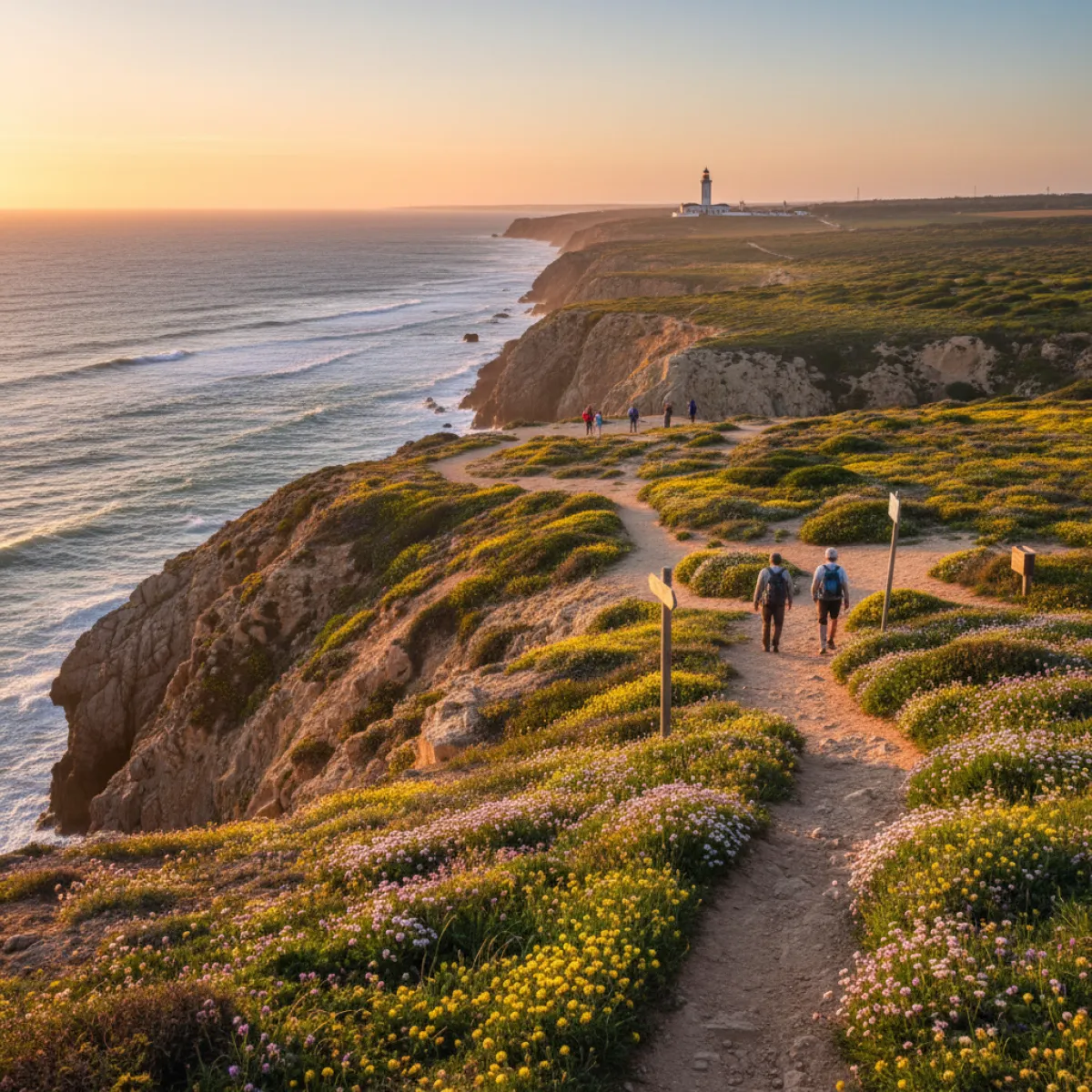
May is when the Rota Vicentina works best. I'll say it plainly. In July and August, the heat turns certain stages into an endurance test nobody signed up for. In March, the lateral wind on cliff sections makes you question your life choices. But in May, Portugal's southwest coast delivers temperatures between 18 and 24 degrees, wildflowers blanketing the fields, and trails you can walk midweek without seeing another soul for hours.
The Rota Vicentina splits into two main routes: the Fishermen's Trail, which hugs the coastline with sections demanding real attention to terrain, and the Historical Way, an inland path through rural villages and cork oak landscapes where time seems to have slowed down two decades ago. Sagres is the ideal starting base for both, and here's why.
The Fishermen's Trail: What Nobody Tells You
The Fishermen's Trail is the photogenic one and, consequently, the popular one. It covers roughly 226 kilometres between Porto Covo and Sagres, split into 13 stages. You don't need to do it all. Most people don't, and that's perfectly fine.
The final two stages ending in Sagres are among the best on the entire route. The stretch between Vila do Bispo and Sagres (about 22 km) passes cliffs where erosion has carved shapes that look like contemporary sculpture. The terrain is uneven, with loose sand sections and descents that demand boots with proper grip. Trail runners won't cut it here, no matter what someone on Instagram told you.
The preceding stage, Carrapateira to Vila do Bispo, is equally spectacular but more demanding. That's 22 km with minimal shade. In May, this is manageable. In August, it's reckless without at least 3 litres of water per person.
Practical Tips for the Fishermen's Trail
- Start early. On the trail by 7:30am means you're done by 1pm and can have lunch without rushing.
- Wear sunscreen even under clouds. The sea breeze deceives you, and the May sun in the Algarve already burns.
- There are no reliable water sources along the coastal sections. Carry enough for the full stage.
- Signposting is excellent: blue and green markers on posts. If you haven't seen a marker in 10 minutes, you've probably gone off trail.
The Historical Way: The Trail That Deserves More Attention
If the Fishermen's Trail is the Instagram star, the Historical Way is the undersold alternative. This inland route from Santiago do Cacém to Sagres passes through cork oak woodlands, rural villages, and dirt paths where you can walk an entire morning without crossing another hiker.
The final stage of the Historical Way, entering Sagres from the interior, offers a completely different perspective of the region. Instead of cliffs and sea, it's fields of cistus in bloom (May is peak flowering season), dry stone walls, and the occasional goat herd regarding you with a profoundly Algarvian indifference.
For those wanting to combine hiking with local knowledge, the Walking Sagres: Megaliths and Fortress experience is an excellent way to contextualise what you see on the trails. The region has megalithic remains that most hikers walk right past without knowing, and having someone explain the history behind the stones turns a walk into a field class.
Sagres as a Base: Where to Stay and Why
Sagres works as a base for three reasons: it sits at the southern tip of the route, it has accommodation for various budgets, and it's small enough to navigate entirely on foot. The town essentially concentrates along two parallel streets, with restaurants, minimarkets, and surf shops.
For accommodation, expect hostels from around €20-25 per night for a dorm bed and private rooms in guesthouses from €50-70 in May. Book ahead, particularly if you're travelling over the May 1st long weekend.
After a day on the trails, Jardim de Sagres is a pleasant spot to stretch your legs in the late afternoon without the effort of another hike. Nothing grand, but exactly the kind of green space you want after 20 km of trail.
Eating in Sagres After the Trails
Sagres isn't Lisbon in gastronomic terms, but it has half a dozen honest spots. Grilled fish is the safe bet: sea bream, sea bass, or the catch of the day, almost always fresh. Count on €12-18 for a grilled fish plate with sides at local tascas. Cataplana de marisco, when available, costs more (usually for two, €30-40) but is worth it after a day of effort.
Avoid the restaurants directly on Praça da República at weekend lunchtimes. Concentrated tourism, inflated prices, plates arriving lukewarm. Move one street away and the experience improves considerably.
Rest Day: Alternatives to Hiking
If you're planning three or four days in Sagres, alternate a day off from the trail. Your muscles will thank you, and there's plenty to do.
For those wanting to explore the coast differently, the Jeep Safari along the Costa Vicentina covers areas inaccessible on foot and gives a panoramic view of the landscape you've been walking through. It's particularly useful for understanding the real scale of the coast and spotting beaches you'd otherwise never find.
Lagos is 30 minutes by car or about an hour by bus, and makes the perfect complement for an urban day. Our Lagos neighborhood guide helps you navigate the city beyond the marina and the obvious old town.
Logistics: Getting There and Getting Around
The nearest airport is Faro, about 115 km away. By car, it's roughly 90 minutes via the A22 motorway then the EN125. Without a car, Rede Expressos runs the Faro-Lagos connection, and from Lagos you catch the local Vamus Algarve bus to Sagres. The total public transport journey takes between 2.5 and 3.5 hours depending on connections.
If you're doing linear stages on the Fishermen's Trail, you need to solve the return to your starting point. Two methods: taxi (agree on the price beforehand, expect €20-40 depending on distance) or the transfer service that some local companies in Sagres and Vila do Bispo offer. Check locally, as schedules and availability change year to year.
A rental car is useful for the Historical Way, where stage start and end points aren't always served by public transport.
What to Pack
For day stages without overnight camping:
- Hiking boots with good grip (non-negotiable for the Fishermen's Trail)
- Minimum 2 litres of water per person
- Sunscreen and a hat
- An extra layer: in May, temperatures can drop to 14-15 degrees in the early morning on windy cliff sections
- Energy snacks: nuts, bars, fruit
- Charged phone with Rota Vicentina maps downloaded offline (the official app works well)
May vs. Other Months: An Honest Comparison
September and October are also good months, with the advantage that the sea is warmer for a post-stage swim. But in May, the vegetation is at its peak. The wildflower fields between Carrapateira and Vila do Bispo in particular are something that simply doesn't exist in autumn.
June works, but temperatures already climb to 28-30 degrees and hiker numbers increase significantly. May is the last month before the Algarve switches into summer mode.
For those wanting to extend the trip and explore the Algarve beyond the trails, it's worth discovering the traditions and culture of Faro or the local culture in Albufeira, which has considerably more character than its reputation as a bar strip would suggest.
The Verdict
The Rota Vicentina in May, based out of Sagres, is probably the best coastal hiking experience in Portugal. The trails are well maintained, the signposting is reliable, and the combination of dramatic cliffs with fields in bloom is hard to beat. You don't need to be an athlete: the stages are demanding but doable for anyone with reasonable fitness and proper footwear. Come before June brings the heat and the crowds. Sagres in May is exactly this: an entire coastline practically to yourselves.