Loulé: The Market Where Craftspeople Refuse to Disappear
On Rua da Barbacã, five coppersmiths still hammer copper by hand. At the Casa da Empreita, Maria Odete Rocha has been weaving palm since age seven. Loulé's 1908 Municipal Market anchors a craft tradition that refuses to become a museum piece.
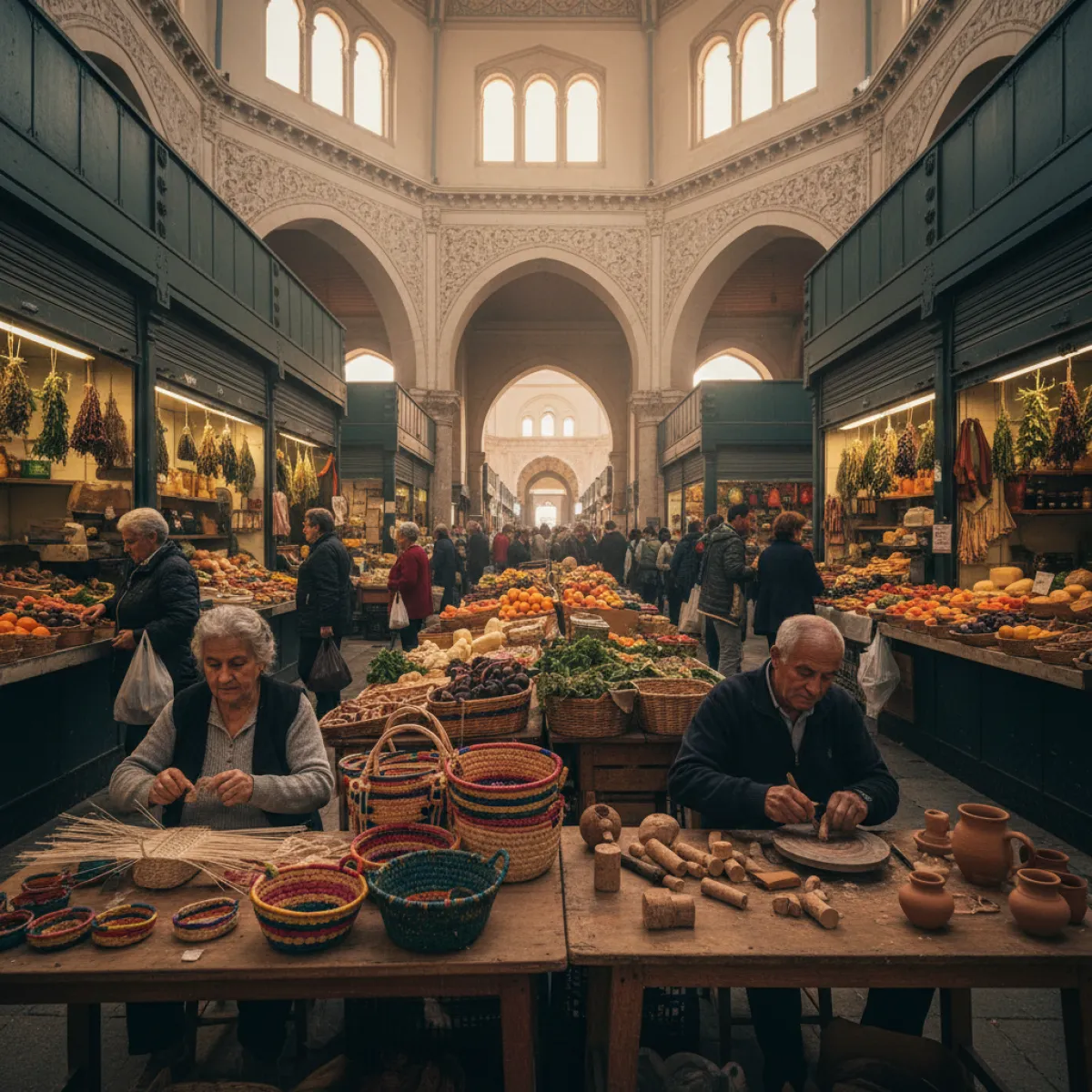
At seven in the morning on Praça da República, Loulé's Municipal Market is already wide awake. Fishmongers slam polystyrene boxes onto the stone floor, fruit stalls line up figs and oranges with surgical precision, and the smell of fresh coriander mixes with espresso from one of the market counters. This has been happening every day, Monday to Saturday, since 1908. The building, designed by Lisbon architect Alfredo Costa Campos, features Moorish-inspired arches and domes that could belong to a North African medina. But Loulé Market isn't a monument for tourists to photograph and move on. It's a place where people buy, haggle, talk and eat.
A 118-Year-Old Building with Zero Cobwebs
The market's history is one of disputes and compromises. In the years before construction, two local parishes fought over who would host it. The original project included towers and additional shops that were cut to reduce costs. In 2007, after a deep renovation that reinforced the structure with metallic elements without sacrificing its character, the market reopened with the same purpose it has always served: feeding the city.
Today, 29 shops and 90 stalls are spread across four pavilions. Fish arrives fresh from the Algarve coast, vegetables are often harvested the same day by regional farmers, and herbs come from gardens within twenty kilometres. It's a market that still functions as a market, which, in 2026, is already a form of resistance.
The Workshops Hiding Behind the Market
The real surprise in Loulé is in the narrow streets behind the market. In the old town's area of Arab influence, small workshops keep their doors open to the street, as they have for centuries. These aren't souvenir shops in disguise. They're working spaces where you can hear copper being hammered and watch palm being woven, live and unrehearsed.
On Rua da Barbacã, the Oficina de Caldeireiros (Coppersmith Workshop) occupies the same space where the old Caldeiraria Louletana once operated. Five coppersmiths work here, hand-hammering copper and brass to produce pots, pans, cataplanas and decorative objects. Analide Carmo has been a coppersmith since the age of twelve. David Ganhão Cabrita, from a different generation, makes copper jewellery and decorative pieces, proving tradition can evolve without betraying itself.
On Rua Vice-Almirante Cândido dos Reis, the Casa da Empreita (Palm Weaving House) brings together around a dozen palm weavers. The process is slow and mesmerising: strips cut from dwarf palm leaves are interlaced to create baskets, bags, mats and decorative pieces. Maria Odete Rocha has been doing this since the age of seven. Born in 1955, she developed a gradient-dyeing technique that turns a functional basket into a design object. Inácia Coelho, born in 1934, commands a braiding precision that defies her age. Every piece that leaves her hands takes hours of work no machine can replicate.
Esparto and Ceramics: The Other Crafts
Beyond palm and copper, Loulé maintains esparto grass traditions, centred especially in the village of Alte. Esparto, a resistant plant fibre, is soaked and beaten with wooden mallets until pliable, then braided into baskets, mats and ropes. In ceramics, artisans like José Machado Pires produce the "Tigelas do Algarve" (Algarve Bowls), painted with motifs that blend sea and mountain, capturing the Algarve's divided landscape.
If you want deeper context on the town's cultural heritage, the Loulé Museum Marathon routes you through all seven museum hubs in the municipality.
Saturday at the Market: A Different Beast
Monday to Friday, the market belongs to locals. On Saturdays, it spills into the surrounding streets and becomes an open-air producers' market. More craft stalls, ceramics, textiles and regional products appear. The energy shifts. It's louder, busier, more touristy, but still genuine.
In the market's food court, between 12:30 and 14:30 on Saturdays, there's a DJ. It sounds strange in a century-old market, but it works. The idea is to keep the space alive and relevant, not to embalm it. If you prefer something quieter, come during the week, early morning. It's a different market entirely.
What to Eat and What It Costs
The food court operates Monday to Saturday, 11am to 8pm. There are options for every budget. For a cheap and good meal, look for the daily specials at the prepared food stalls. A cataplana for two at one of the restaurants around the market runs between €25 and €35, depending on the catch of the day. Check locally, because prices shift with the season.
At the market, products to take home include mountain honey, fig preserves, almond liqueur and medronho (arbutus berry spirit). These are souvenirs that last longer than a fridge magnet and taste better.
Getting There and When to Go
Loulé sits 16 kilometres from Faro, about twenty minutes by car. Regular buses run on the Vamus Algarve network between Faro and Loulé. The market is open Monday to Saturday, 7am to 3pm. The artisan workshops in the old town keep variable hours, but are generally open in the morning. Best advice: arrive early. By 8am there's enough activity to feel the place's rhythm, but enough room to talk to the people selling.
If you're staying in the area, CASA BRAVA is a local rental in Loulé that lets you wake up in time to reach the market before the crowds.
Loulé Criativo: The Strategy Behind the Survival
None of this happens by accident. The Loulé municipality, through its Loulé Criativo programme, actively invests in revitalising traditional crafts. There's training, workshops, artistic residencies and creative tourism connecting traditional artisans with contemporary designers. The Loulé Design Lab has hosted exhibitions where designers and craftspeople collaborated on pieces that bridge tradition and innovation, like Maria Odete Rocha's gradient palm bags or Jürgen Cramer's folded copper shelving.
In 2019, the municipality received Portugal's National Crafts Award, recognising the work done to keep these arts alive. This isn't nostalgia. It's strategy: if craftsmanship doesn't adapt, it dies; if it adapts without respecting its roots, it gets lost. Loulé is trying to find the balance.
Beyond the Market
Loulé is more than its market, of course. The Loulé mountains offer landscapes that contrast radically with the coast, and for those looking to slow down, yoga at the Wild View retreat is one way to experience the Algarve's interior differently.
If your interest is the Algarve's local culture as a whole, it's worth cross-referencing these discoveries with what Faro and Albufeira offer. Our guide to Faro's local culture covers the traditions of the district capital, while the Albufeira guide proves there's much more beyond the Strip.
But the market is the heart of it. Not because it's beautiful (it is), not because it has history (it does), but because at 7am on a Tuesday in April, there are people here doing exactly what their parents and grandparents did in the same spot. And that, in 2026, is rare. Go while it lasts.