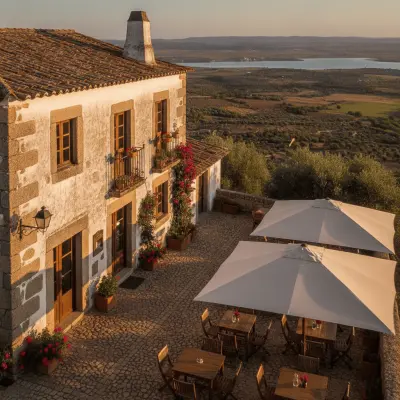
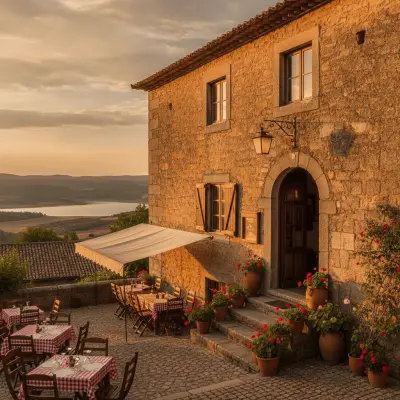
Monsaraz in Stone: A Walking Route Inside the Walls
A street under three hundred metres long, a castle with a bullring built inside it, and five thousand years of stone deliberately aligned. This route walks Monsaraz the way it was built: slowly, and without wasting an inch of space.
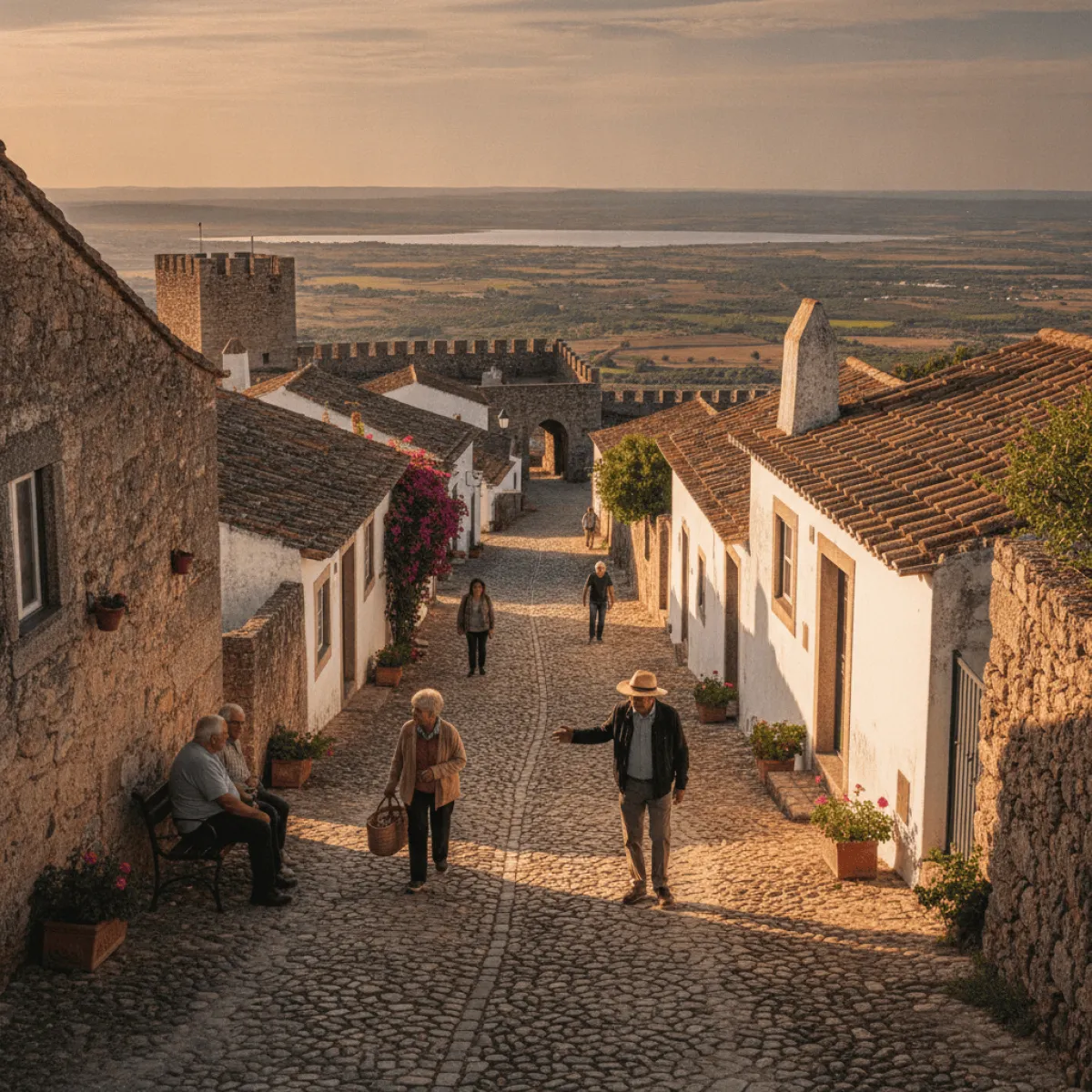
You don't really walk Monsaraz, you fold into it. The whole village sits on a ridge so narrow that Rua Direita, the single street running its entire length, measures under three hundred metres. That's good news: you can't get lost, and it also means every corner, every stone doorframe, every gap in the wall was built to last centuries, because there was never any spare stone to waste. This is a route for people who like architecture without pretence: whitewash, granite, slate, and an economy of means that any minimalist architect would sign off on today.
Getting there and when to go
Monsaraz sits about 15 km from Reguengos de Monsaraz, within the same municipality, and just over an hour by car from Évora. There's no train and no bus worth timing your day around, so plan on driving. Parking is outside the walls, in a lot by the main entrance, free for most of the year, and you cover the village entirely on foot from there. Go early, before 10am, or late afternoon after 5pm. At midday in July and August, tour buses unload full groups onto Rua Direita and the experience of walking between whitewashed houses turns into a queue of people photographing craft shop windows. Outside those hours, and especially outside high season, the village goes back to belonging to the people who actually live there, still fewer than a hundred permanent residents.
Through the town gate
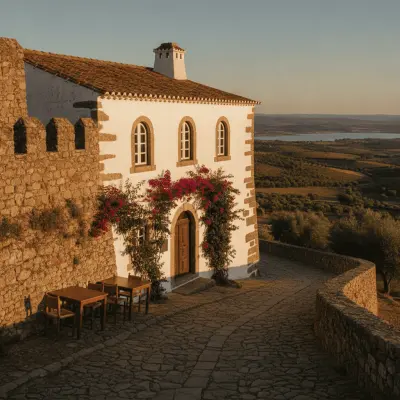
The route naturally starts at one of the gates in the medieval wall. What you see today is mostly the result of 13th and 14th century rebuilding, after the Christian reconquest, but the site was strategic long before that: whoever controls this ridge controls the view over the Guadiana valley. The walls are schist and local granite, laid without refined mortar, just enough to survive sieges and to still be standing seven hundred years later. Look at the thickness of the wall sections near the main gate, and at how the access road forces a turn, a common trick in medieval military architecture to slow down any frontal attack.
Rua Direita: a lesson in Alentejo vernacular architecture
From the entrance, Rua Direita climbs gently toward the castle. This is the best of Alentejo vernacular architecture, condensed into a single street: single storey or one-plus houses, thick walls painted white (the lime isn't decoration, it's thermal insulation, keeping interiors cool in August's 40-degree heat), and colour bands, blue or ochre, around doors and windows, a tradition tracing back to using copper sulfate in the paint to keep insects away. Look closely at the granite stonework: door jambs, lintels and thresholds cut from single pieces, stonemasonry that would cost a fortune today and here is simply normal, invisible, functional. Many of these houses have dates carved into their lintels, 17th and 18th centuries, proof the street never stopped being lived in and remodelled over time.
It's not a museum street, even though it can look like one. There's still laundry drying from windows and cork oak firewood stacked in courtyards. That mix of everyday life and picture-perfect setting is exactly what makes Monsaraz different from other historic villages tidied up purely for visitors.
The pillory and the old town hall
Halfway up, in the old central square, stands the Manueline pillory, a stone column that once marked the village's legal autonomy, and the building that served as its former town hall. It's a clear example of how these small Alentejo squares organised civil, religious and commercial power within a fifty-metre radius: everything the village needed to function fit right there.
Igreja Matriz de Nossa Senhora da Lagoa
Continuing up, the parish church, dedicated to Nossa Senhora da Lagoa, rises with a 16th-century Mannerist facade, sober rather than showy, as is typical of the Alentejo interior. Inside is a Gothic tomb attributed to a former governor, and the plainness of the naves contrasts deliberately with the Baroque richness found in churches of larger cities like Évora. The architectural message here is different: austerity as a form of devotion, not poverty.
The castle, and a bullring inside the walls
At the top sits the Castelo de Monsaraz, built on the orders of King Dinis in the early 14th century over an earlier fortification granted to the Knights Templar. Unusually, the castle walls wrap around a small popular bullring built inside the enclosure, between the keep and the wall itself. It's a strange and fascinating overlap: medieval military architecture repurposed, centuries later, for popular bullfighting, while never ceasing to double as a lookout point. Climb to the wall walk for the view over the Alqueva reservoir, the largest artificial lake in Western Europe, which since 2002 has completely reshaped the landscape and economy of this part of the Alentejo.
Before the walls: five-thousand-year-old architecture
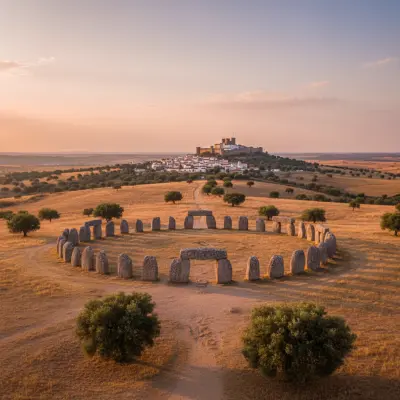
If this route were only about medieval stone, it would be incomplete. About a ten-minute drive from Monsaraz sits Cromeleque do Xerez, a Neolithic megalithic complex proving this landscape was already being organised architecturally long before any castle existed. The standing stones were relocated in the early 2000s because of the rising waters of the Alqueva reservoir, one of the few cases in Portugal of a prehistoric monument literally being moved to survive a modern hydraulic project. It's worth the detour as a counterpoint: first came stones aligned with the sun, then walls aligned with war, then houses aligned with the street. Same logic of organising space, three thousand years apart between each layer.
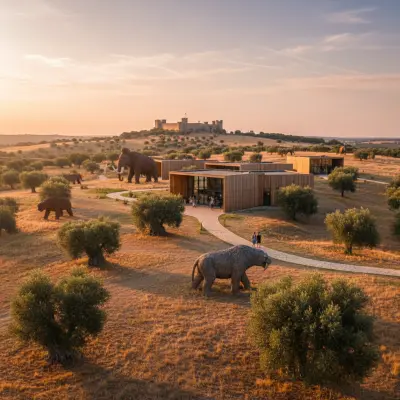
For anyone who likes outdoor sculpture on a different scale, Parque Megafauna Monsaraz offers an almost comic contrast after so much ancient stone: a park of large-scale animal replicas, aimed mostly at families travelling with kids who need to burn off energy after a morning of climbing and descending inside the village.
Where to eat after the walk
Coming down the ridge works up an appetite, and Monsaraz has serious options for a village this small. Taverna Os Templários plays on the name of the order that once held the castle, but what matters is straightforward Alentejo cooking: migas, stews, Serpa cheese to start. Order the açorda if it's on the day's menu, it's the dish that separates a real tavern from a tourist trap. For a slightly more refined meal that stays true to the Alentejo without playing it safe, Sahida is the better bet, especially if you want a terrace with a view. Xarez Restaurante Bar, meanwhile, works well for a slower late afternoon, petiscos and a glass of red as the sun drops over the Alqueva, a good way to close the day without rushing.
At night: the sky the reservoir helped protect
Monsaraz sits inside the Dark Sky Alqueva Reserve, one of the first in the world with that certification, and the lack of light pollution here is as real as the architecture you see by day. After dinner, it's worth trading cobbled streets for a stargazing session. Two organised experiences in the area are worth booking ahead: Stargazing in Monsaraz: The Dark Sky Alqueva Experience, more informal and built for people staying in the village, and Celestial Precision: Astronomical Observation at the Alqueva Lake Observatory, at a dedicated observatory with stronger telescopes and technical explanation of what you're actually looking at. If you only have one night in Monsaraz, this is the activity that justifies staying instead of driving on at sunset.
To cool off: the river beach
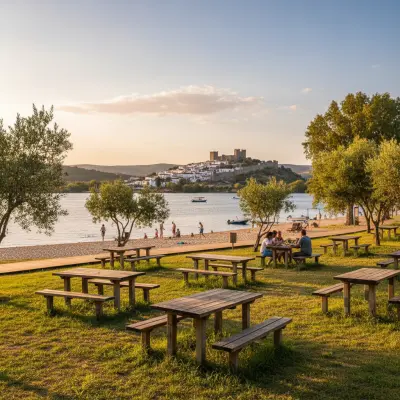
With Alentejo heat, especially between June and September, a whole morning climbing cobbled streets calls for a break by the water. Parque de Merendas da Praia Fluvial de Monsaraz sits right by the reservoir, with shaded trees and picnic tables, a simple, no-frills spot to eat a packed lunch and take a dip before heading back into the village for sunset.
How much time to set aside, and what it costs
The route inside the walls can be done comfortably in two to three hours, including the climb to the castle and a stop at the church. Entry to the village is free, and the castle doesn't charge admission to the wall walk either. Stargazing experiences typically run between 15 and 30 euros per person, depending on the operator and equipment, and should be booked in advance, especially on new moon nights when demand rises. A full meal at one of the village taverns generally runs between 15 and 25 euros per person, wine included.
Heading north from here
If Monsaraz is only the first stop on a longer trip through inland Alentejo, it's worth adding Portalegre to the itinerary, further north in the district of the same name. The guides Portalegre on Foot: Neighborhoods Worth the Walk and Portalegre Without the Tourist Traps: A Weekend help plan that second leg without falling into the obvious mistakes of someone just passing through.
Monsaraz doesn't need metaphors to impress. It just needs someone to actually look at a granite lintel, count how many centuries separate a cromlech from a castle, and accept that a village with a three-hundred-metre main street can eat up an entire afternoon without you noticing.