Monsaraz: An Architectural Walk Through the Walled Village
Inside Monsaraz's walls sits a 15th-century fresco that stayed bricked up for four hundred years, a bullring inside a medieval castle, and a view over Western Europe's largest artificial lake. A walking route, no car needed, from the town gate to the top.
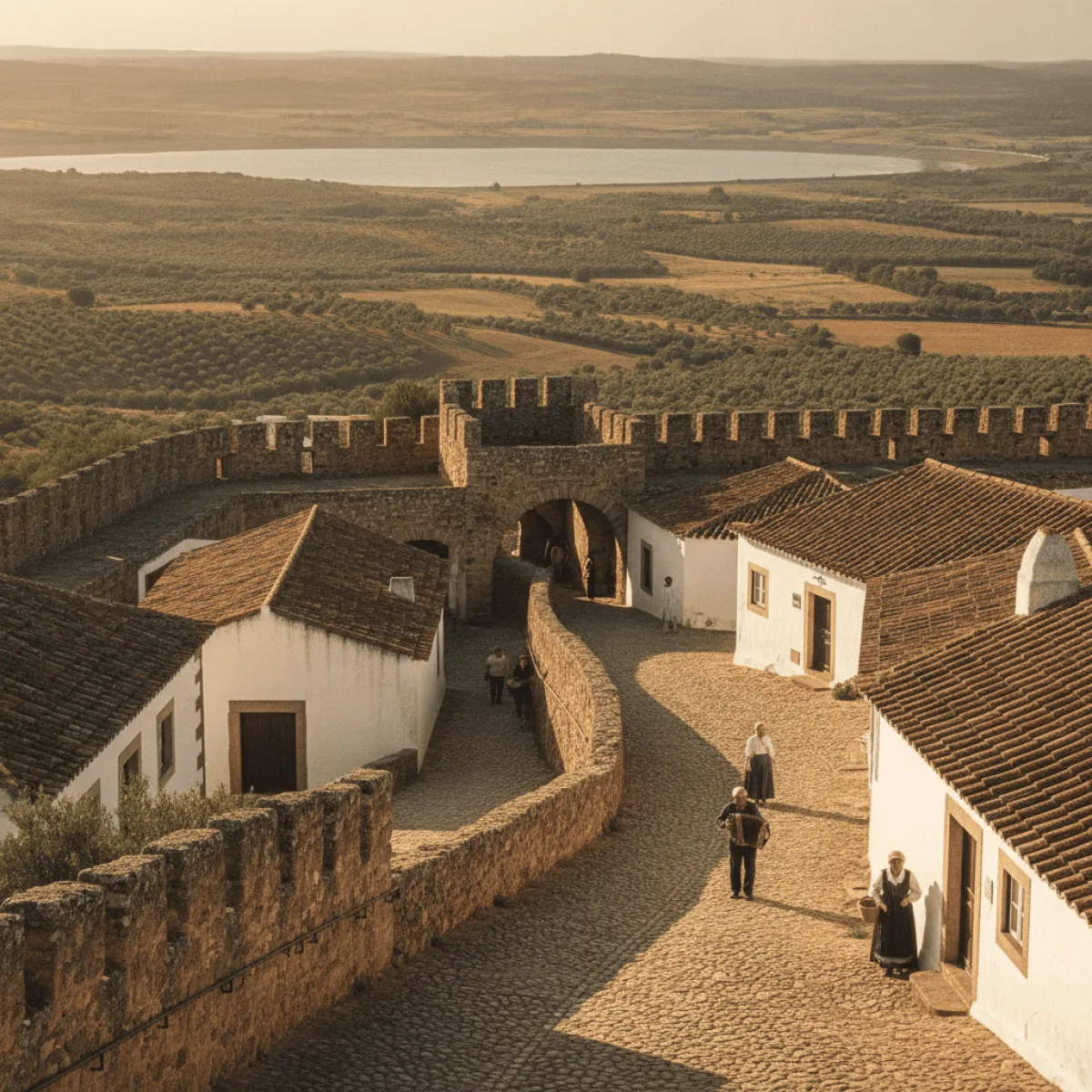
Monsaraz is not a place you drive through, it's a place you climb. The village sits on a granite hilltop over 300 metres up, facing the Alqueva reservoir, and it was built to be seen from a distance and defended up close. That has one very practical consequence for visitors: forget the car. The streets inside the walls are narrow and cobbled, and parking is outside, near the Porta da Vila (the town gate). From there, everything happens on foot, which is really the only way to understand the logic of the place: a fortified hilltop village that grew inside a defensive perimeter and never had room to waste.
Starting point: the town gate and the medieval layout
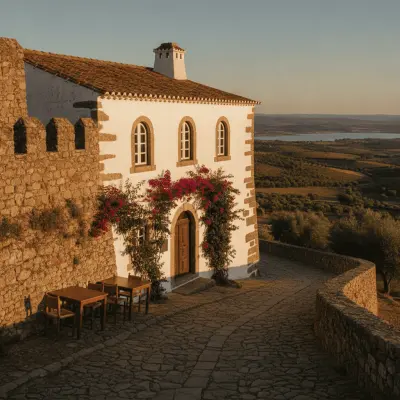
You enter through one of the gates in the wall, and the first thing that hits you is the scale. Inside the walls, Monsaraz measures little more than three hundred metres end to end. There are no avenues, only alleys opening onto courtyards and whitewashed houses with ochre or blue trim along the base, a common feature of Alentejo popular architecture that helped hide street grime and, according to some accounts, kept insects away thanks to the copper sulphate mixed into the lime wash. Walk up Rua Direita, which despite the name is not entirely straight, and notice how the doors sit almost flush with the street: no setbacks, no front gardens, because space inside the walls was too valuable to waste on grand facades.
Rua Direita: the spine that tells the village's story
If Monsaraz has a backbone, it's Rua Direita. It's here you'll find one of the strangest and most rewarding buildings in the village: the old Paços da Audiência, also known as the Casa do Tribunal, built in the mid-14th century. Hidden inside for centuries behind a brick partition wall and only rediscovered in 1958, is the fresco of the Good and Bad Judge, painted around 1498 and 1499 on commission from D. Jaime, 4th Duke of Braganza. It's a genuine piece of medieval justice iconography: on one side, the upright judge, holding his staff straight, solemn and dignified; on the other, the corrupt judge, double-faced, his staff broken, with a demon peering over his head. It's worth going inside for this alone. There aren't many frescoes from this period and of this quality surviving in small Alentejo villages, and the fact that it survived by being bricked up for centuries is, on its own, a good story.
The parish church and the Manueline pillory
Further along Rua Direita you reach the Igreja Matriz de Nossa Senhora da Lagoa, plain in design, built over an earlier Gothic structure, with an interior worth seeing mostly for its restraint: no Baroque excess here, this is a border-village church built to last, not to impress. Next to it stands Monsaraz's pillory, carved in Manueline style, a good reminder that this village had its own royal charter and administrative autonomy since the Middle Ages. It's not the most photographed pillory in the Alentejo, but it's one of the best preserved, and it's worth a couple of minutes to look at the carved detail on the column.
The castle and the bullring inside the walls
The high point of the route, literally and otherwise, is the castle, at the far end of the village. Built during the reign of D. Dinis over an earlier fortification, it has a detail that surprises most first-time visitors: inside the castle courtyard sits a bullring, still used for local festivities today. It's an odd, very Portuguese layering of history, a medieval military space repurposed for popular bullfighting centuries later, with nobody bothering to change the structure to fit. Climb up onto the walls (access is free and there's no strict schedule, though you should avoid going after sunset without a torch, since lighting up there is minimal) and look out at the Alqueva. On a clear afternoon, you'll see water in almost every direction: Western Europe's largest artificial lake surrounds the village like a peninsula, and it's from up here that you understand why medieval builders chose this particular hilltop and no other.
Where to stop and eat along the way
A proper architectural walking route needs pauses, and Monsaraz has options that aren't tourist traps, despite the fact that the village lives almost entirely off tourism. For a slow, traditional meal, Taverna Os Templários keeps things honest: Alentejo cooking without unnecessary reinvention, the kind of place where you order açorda or a game dish on a cold day and don't go wrong. If you'd rather sit somewhere more casual with a terrace and a broader menu, Xarez Restaurante Bar works well mid-afternoon, after the climb to the castle, when what you actually want is to sit, drink something cold, and look down at the village below. For quicker bites between stops on the route, Sahida is a useful option, especially if you're walking the route with kids and need something that doesn't require an hour sitting down.
Beyond the walls: what's worth a short drive
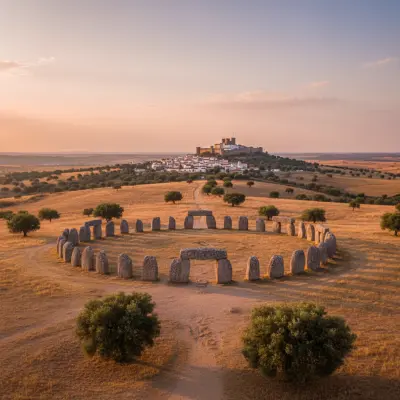
Monsaraz's architecture doesn't end at the walls, but the surrounding landscape helps explain why the village sits where it does. A few minutes' drive away is the Cromeleque do Xerez, a megalithic stone circle that's a reminder this landscape was inhabited and organised long before any medieval castle, its standing stones predating the village by thousands of years. It's a good archaeological counterpoint to the urban route: if the village tells the story of medieval defence and administration, the stone circle tells the story of whoever was here long before any of that began.
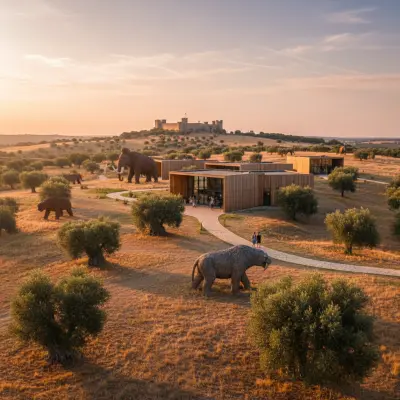
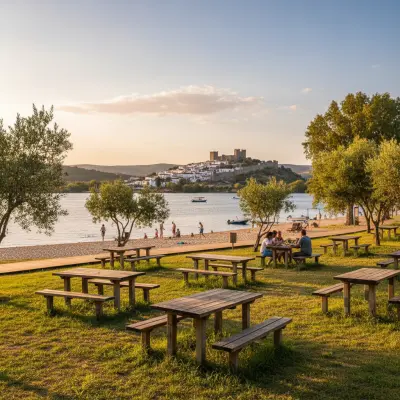
If you're travelling with kids, or just want to swap stone for something else for a few hours, Parque Megafauna Monsaraz is an easy stop to fit in after a morning in the village, and the Parque de Merendas da Praia Fluvial de Monsaraz works well for a picnic by the water before heading back up the hill for sunset, which in Monsaraz is, without exaggeration, one of the best in the Alentejo.
After dark: Monsaraz isn't only about daytime architecture
After dinner, don't head straight for the car. Monsaraz sits inside the Dark Sky Alqueva Reserve, one of the first certifications of its kind in Europe, and the near-total absence of light pollution inside the walls makes the village one of the best stargazing spots in the country with no equipment at all. For anyone who wants to go further than looking up with the naked eye, there are two organised experiences worth considering: Stargazing in Monsaraz: The Dark Sky Alqueva Experience, closer to the village itself, and Celestial Precision: Astronomical Observation at the Alqueva Lake Observatory, at the dedicated observatory by the lake, with proper telescopes and someone on hand to explain what you're looking at. It's an odd but fitting way to end a day that started with a 15th-century fresco: by day, the architecture humans built to defend themselves; by night, the sky that was there before any of it.
Practical information
- The village is around 50 minutes from Évora and just under 1h45 from Lisbon, on national roads for the final stretch.
- There's no parking inside the walls: leave the car at the lot near the Porta da Vila and do the whole route on foot, the full walk takes between 1h30 and 2h30 with stops.
- Access to the walls and castle is free; the Fresco Museum (the old Paços da Audiência) keeps its own hours and charges an entry fee, so check locally before you go.
- Go early morning or late afternoon: at midday in July and August the stone reflects heat and the streets fill up with tour buses.
- Wear shoes with good grip: the cobblestones are uneven and get slippery after rain.
For anyone who likes walking towns instead of driving through them
If this route leaves you wanting more, the Alentejo has other examples of urban architecture that reward walkers over drivers. Portalegre, further north, has a historic centre that's less touristy but just as dense in history, and it's worth a look at our guides to the city: Portalegre on Foot: Neighborhoods Worth the Walk follows the same logic as this route, neighbourhood by neighbourhood, and Portalegre Without the Tourist Traps: A Weekend helps plan a full weekend without falling into the obvious first-timer mistakes. And if all that walking works up an appetite, Portalegre's Real Food: Where Locals Actually Eat handles the food side with the same approach we've used here in Monsaraz: fewer photogenic spots, more places where the food is actually good.
Monsaraz is small enough to see in a day but dense enough to be worth a return trip. Few Portuguese villages manage to pack a castle, a bullring, a rediscovered medieval fresco, and Western Europe's largest artificial lake at the door, all within three hundred metres of main street. The climb is worth it.