Dark Sky Alqueva: How to Plan a Night in Monsaraz
From the Moon's phase to the IPMA forecast, a practical plan for choosing an observatory, preparing red lighting and saving the night when the sky becomes overcast.
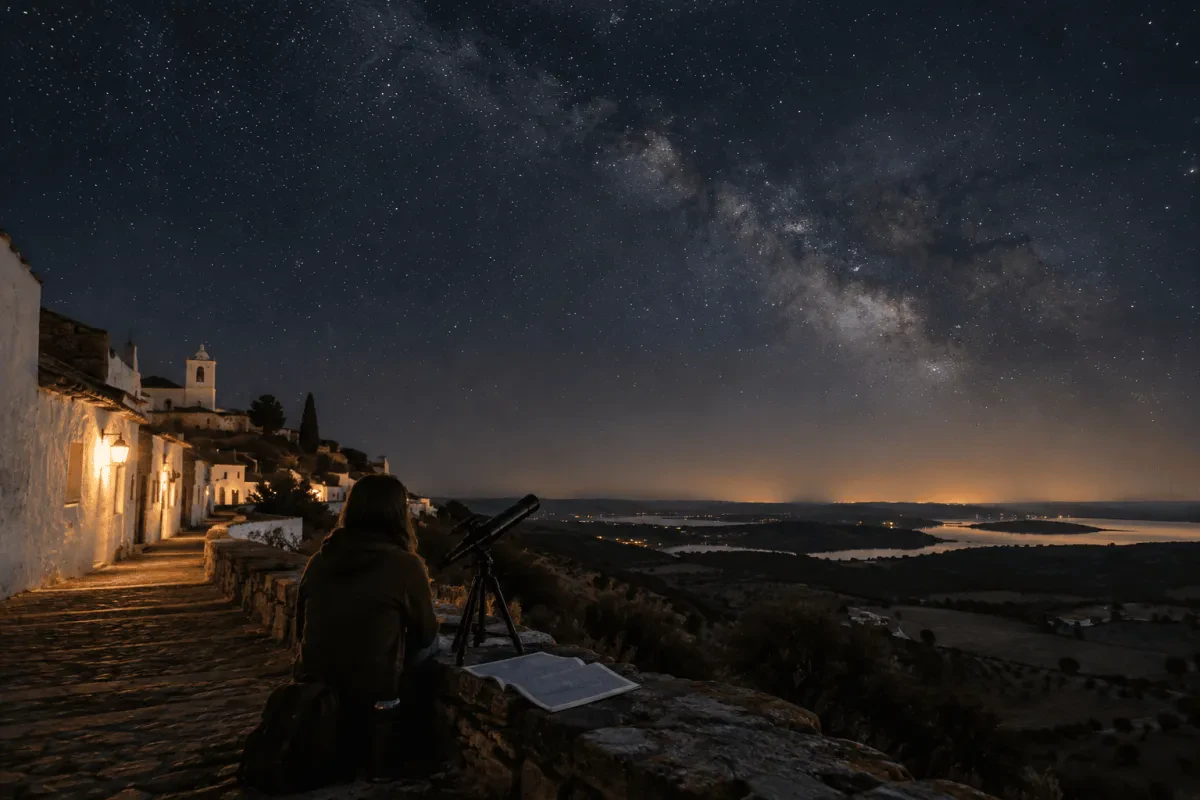
A first night of stargazing goes better when you decide in advance what you want to do. Seeing constellations with the naked eye, observing the Moon and searching for faint galaxies do not require exactly the same conditions. In Monsaraz, there is another important distinction: the Official Dark Sky Alqueva Observatory is in the village of Cumeada, while the Alqueva Lake Observatory, known as OLA, is near Monsaraz. Confusing the two locations is a very effective way to start the night in the wrong place.
For your first experience, choose a guided session
The editorial advice is simple: on a first visit, it is more worthwhile to book a guided session than to buy a telescope or hastily search for a dark roadside spot. At the Official Observatory, the experience includes guidance on the night sky and observation through the installed telescopes. You can consult our page about stargazing at Dark Sky Alqueva.
OLA is another option dedicated to astronomical outreach and telescope observation. Its experience is covered in the guide Astronomical Observation at the Alqueva Lake Observatory. Treat both visits as activities that require planning: check the operator's official page, confirm the location provided with your booking and keep the contact details supplied at hand, because the weather decision may be made close to the session time.
If you prefer to observe without a guide, choose only a place where staying overnight is permitted. Familiarise yourself with the terrain while there is still daylight, park completely off the carriageway and identify changes in level or other obstacles before it gets dark. An isolated monument or a rural path does not automatically become a safe observation spot.
The Moon does not ruin the night, but it changes the programme
To search for faint objects such as nebulae and galaxies, the Official Observatory recommends nights with little Moon presence and, in particular, nights away from the Full Moon. Moonlight increases the brightness of the sky background and reduces the contrast of these objects. This does not mean that a night with the Moon is a poor choice: guides can adapt the targets, and the lunar surface itself is especially interesting when viewed through a telescope.
Instead of looking for a supposed universal best time, make your request to the operator precise: do you want to learn about constellations, observe the Moon or try to see deep-sky objects? The answer makes it possible to choose a suitable date without relying on generic calendars or lists of astronomical phenomena that may not correspond to the visit schedule.
How to read the weather forecast without cancelling too early
Check the IPMA hourly forecast for the nearest locality, first a few days in advance and again on the day itself. The four useful details for this decision are the weather conditions, probability of precipitation, wind and feels-like temperature. The latter helps you choose your clothing; the remaining variables help determine whether outdoor observation is in doubt.
There are two points to bear in mind when reading the forecast. The times shown by IPMA are in UTC: in mainland Portugal they match local time in winter and are one hour behind during daylight saving time. In addition, the institute itself warns that models may misplace cloud cover and precipitation by 30 to 50 kilometres and the timing of the event by around one to three hours. An uncertain forecast therefore does not replace confirmation from the observatory.
| Sign | Practical decision |
|---|---|
| Mostly clear skies and no precipitation forecast | Keep the plan, but check any instructions from the operator. |
| Variable cloud cover | Do not cancel on your own initiative. Conditions may change close to the session. |
| Persistent overcast or rain | Ask whether there will be an indoor activity, rescheduling or another solution. |
| Low feels-like temperature or wind | Wear extra layers and do not rely solely on the jacket you wore during the day. |
Preparation checklist without unnecessary purchases
- Booking and location saved: confirm which observatory you chose and download the directions before setting off.
- Layered clothing and stable footwear: you will be standing outdoors and may walk across poorly lit terrain.
- Adjustable red light: use the minimum intensity necessary and point it at the ground.
- Phone already configured: lower the brightness, activate a red filter if the device allows it and avoid opening white-background apps.
- Water and regular medication: take the essentials with you rather than counting on buying them after arrival.
- Binoculars, only if you already own them: there is plenty to recognise with the naked eye, and a guided session provides access to the observatory's telescopes.
- Chair or blanket, only for an independent outing: first confirm that the location allows people to stay and that you are not occupying private property.
Your eyes may need around 30 minutes to adapt properly to the darkness. Headlights, white torches and bright screens force you to restart part of this process. Arriving early and putting away your equipment before turning off the lights is more effective than trying to organise everything in the dark.
Responsible lighting is also part of etiquette
DarkSky International's guidance can be summarised as using light only when necessary, directing it exclusively at the useful point, choosing the lowest possible level, keeping it on only for as long as essential and favouring warm tones. In an astronomy session, this translates into very specific rules:
- do not shine light at people, telescopes or the horizon;
- keep the red torch pointed downwards;
- do not repeatedly unlock your phone during the observation;
- after parking safely, avoid leaving headlights or interior lights on;
- if you need white light for safety, warn the group and use it only for as long as necessary.
Darkness does not take priority over road safety. Headlights should only be switched off once the vehicle is properly parked, never while driving or manoeuvring on a road.
The plan for an overcast night
Policies may change, so they should be reconfirmed when booking. On the pages consulted on 21 September 2026, the Official Observatory indicated an optional indoor interpretive presentation, or the possibility of rescheduling subject to availability when it was not possible to use the telescopes. OLA indicated that the observation would be replaced by a real-time journey through the universe. Do not assume that overcast skies automatically mean cancellation or a refund.
If you are going out independently, the sensible alternative is to postpone the observation and use the night to learn to recognise the sky with a star chart, preparing for a second attempt. Avoid setting off on an improvised night-time search for clearings between rural roads. Allowing two nights in the region gives you flexibility without turning every weather update into a race.
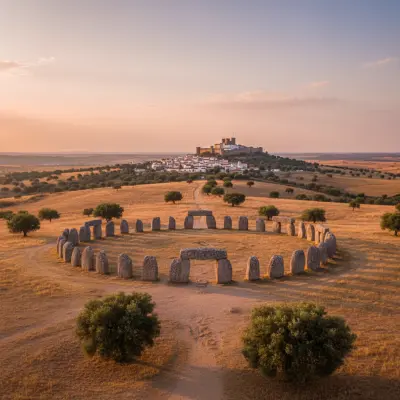
Plan land-based visits during the day. The Xerez Cromlech can be part of that daytime programme, without being treated as a night-time location by default. Likewise, the Monsaraz in Stone route works best before dinner. Afterwards, allow enough time to reach the observatory specified in the booking, put on an extra layer and let your eyes adjust to the darkness.