Évora and Cork Country: A Summer Road Trip
At two in the afternoon in August, the coolest place in the Alentejo is under a cork oak. A road trip from Évora that treats the montado as a destination rather than roadside scenery: reversed hours, gaspacho instead of migas, and Monsaraz after six.
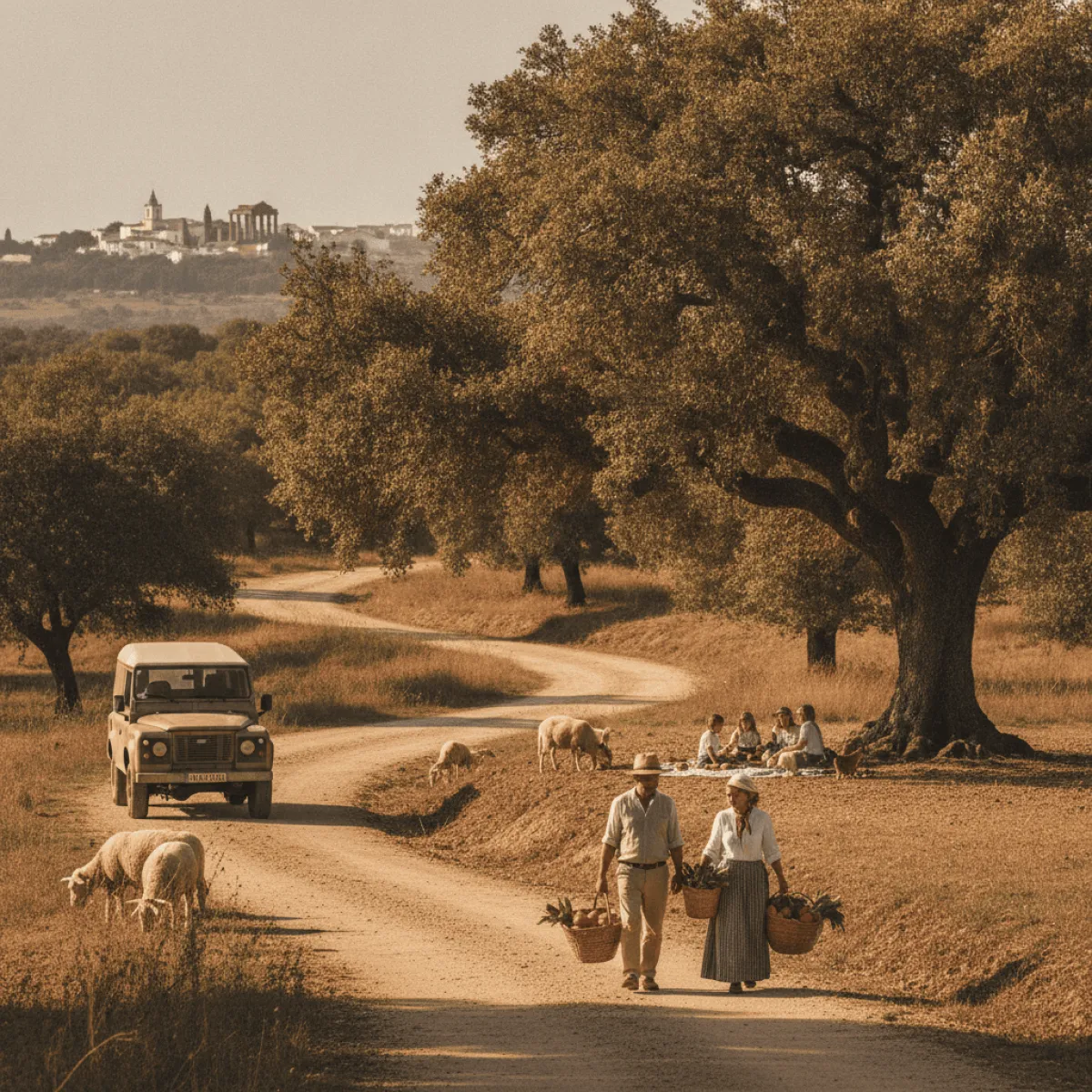
Nobody tells you this about the Alentejo in August: at two in the afternoon, the cork oak woodland is the coolest place in the region. Not the hotel pool, not the inside of a church, not a car with the air conditioning on full. Under a mature cork oak, with a canopy spread out like a thirty-year-old parasol, the temperature drops several degrees and the ground smells of hot dust and dry grass. The pigs have known this for centuries. Tourists keep insisting on visiting the Roman Temple at noon, in shorts, photographing columns and complaining about the heat.
This itinerary starts in Évora and treats the montado, that landscape of cork and holm oaks scattered across gold fields, as a destination rather than as the thing you glance at through a car window on the way somewhere else. It is a summer itinerary, which means it is built backwards: early mornings, slow afternoons, long nights. Anyone who tries to run this on city hours will hate the Alentejo, and that will not be the Alentejo's fault.
Before you set off: where to sleep in Évora
Évora works well as a base. It is under ninety minutes from Lisbon on the A6, has national roads heading out in every direction, and, contrary to what people expect, is a small city you can walk across in twenty minutes.
The real question is budget. If this is a backpacking trip with a rental car split three ways, Old Évora Hostel solves the sleeping problem without eating into the dinner fund, and it sits inside the walls, which matters more in Évora than you would think: it means you walk out at night and walk back, skipping the whole car park gymnastics outside the ramparts.
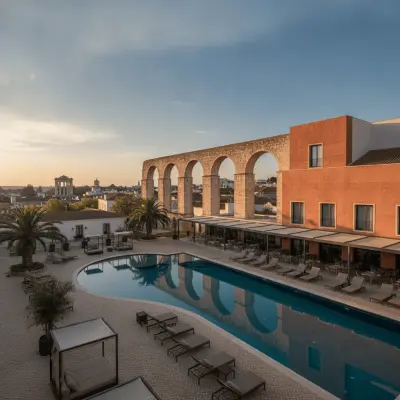
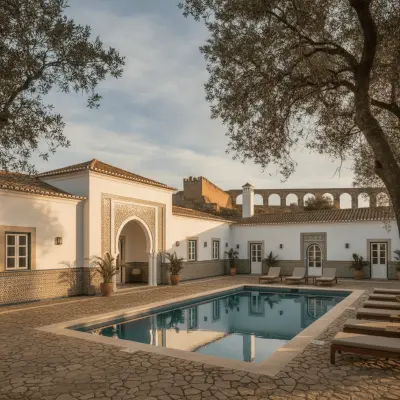
At the other end, and worth at least one night if you are travelling as a couple, is M'AR De AR Aqueduto, tucked against the Água de Prata aqueduct. It is that rare thing: a design hotel that does not pretend the historic building it occupies is an inconvenience. In August, the pool alone justifies the price difference, particularly after a day on the road.
There is a third option, for anyone wanting to push further south and use the Baixo Alentejo as a second base. MouraSuites Hotel works well if you want to split the trip into two blocks rather than driving back to Évora every single evening. Covering 200 kilometres a day in Alentejo heat is the fastest way to turn a holiday into logistics.
The car, minus the romance
There is no alternative to a car on this route. Trains serve Évora and not much else, and buses between inland towns run on schedules designed for people who work there, not people sightseeing. Rent the smallest car available: the streets inside Évora's walls were designed for carts, and there are corners in Monsaraz where an SUV becomes a public humiliation.
Two practical rules. Fill the tank every time you pass a town with a petrol station, because there are stretches of national road running forty kilometres with nothing at all. And take water seriously, four or five litres in the boot. That is not drama, that is August in the Alentejo.
Day 1: Évora, in the right order
The right order is: early. Very early. At half past seven in the morning, Praça do Giraldo belongs to the street sweepers and two or three people drinking coffee standing at a counter. By eleven, it belongs to tour coaches. The gap between those two versions of Évora is enormous, and it costs you nothing but an alarm clock.
Start high, up by the cathedral and the Roman Temple, and walk down. It feels wrong to anyone who likes finishing on a high point, but in July and August you want to be climbing stairs in cool air and descending once the sun is already up.
If you would rather do this with someone who actually knows the material, the Walking Évora experience has the advantage of explaining what you are looking at, which in Évora is more complicated than it appears. There is a Roman layer, a Moorish layer, a medieval layer and a Manueline layer within two hundred metres of each other, and without context it is all just handsome stone.
Around eleven, when the street starts to burn, go into the Museu Nacional Frei Manuel do Cenáculo. Two reasons, one noble and one purely tactical. The noble one: the painting and sculpture collection tells this city's story better than any interpretive panel on the street. The tactical one: it is cool, it is large, and it buys you ninety minutes of shelter for the price of a museum ticket. Take your time in the medieval sculpture section, which is the part most visitors speed through on their way to the paintings.
Lunch, and the afternoon that does not exist
Alentejo summer lunch is a trap for outsiders. The temptation is to order black pork, migas, carne de alguidar, everything that appears on the regional specialities list. Mistake. That is winter food, built for people who worked the fields in the cold. In August, order gaspacho alentejano, which here comes with chunks of bread and sometimes fried fish or presunto on the side, and sopa de cação, the dogfish soup with coriander and vinegar. These are hot weather dishes, designed by people who have lived through this heat for generations.
After lunch, do nothing. Seriously. Between two and five in the afternoon, the Alentejo closes, and there is a biological reason for that. Go back to the hotel, sleep, read, get in the pool. Anyone who tries to tick off monuments in that window will spend the trip irritable and dehydrated.
Day 2: cork country and the road to Monsaraz
This is the landscape day. Leave Évora heading towards Reguengos de Monsaraz and Monsaraz, tank full, no hurry. What matters here is not arriving, it is the road.
At some point the red trunks start appearing. A stripped cork oak has a trunk the colour of fresh rust on the part that has been harvested, and a white number painted on it marking the year of the last stripping. It is the closest thing Portugal has to a forest management system you can read with the naked eye: that number tells you when the tree can be worked again, and the law requires nine years between harvests. A single tree might be stripped fifteen or sixteen times across a life of more than a century.
The work happens in summer, typically between May and August, because that is when the bark releases from the tree without wounding it. If you pass an estate mid-harvest, you will hear it before you see it: dry, rhythmic axe blows, then the crack of a plank pulling free. The strippers start before dawn and stop well before midday. Nobody in the Alentejo, neither visitors nor workers, does anything at three in the afternoon in August.
Pull over somewhere safe, get out, and put your hand on a stripped trunk. It is the cheapest and most memorable thing on this whole itinerary. The obvious rule: do not walk onto private land, and do not touch anything mid-operation. These estates are businesses, not theme parks.
Monsaraz at the end of the day
Monsaraz is a walled village on top of a hill, looking out over the Alqueva reservoir, and it is unarguably beautiful. It is also unarguably packed between ten and five. The fix is simple: arrive at half past six or seven in the evening. The coaches have gone, the light turns low and gold, and the white cobbled lanes empty out.
Park outside the walls, which is compulsory anyway, and walk up. Go as far as the castle, look out over the Alqueva, then come down slowly. The village is tiny, forty minutes covers it, and the whole value is in seeing it without the crowd. After sunset, this is one of the darkest sky areas in Europe, certified as a starlight reserve. If there is no moon, it is worth sitting in the car for another half hour with the lights off, just looking up.
Day 3: dried flowers, markets and the slow gear
By the third day, most people notice they have slowed down without deciding to. That is the right moment to do something with your hands instead of looking at more monuments.
The wildflower workshop with Catarina Ferreira is exactly that: learning to build arrangements from local flora, dried and tough, the kind that survives Augusts like this one. It sounds niche, and it is, but it is also the fastest way to understand why the Alentejo landscape looks the way it does. After two hours handling these plants, you look at the roadside verge differently.
For the morning, find a municipal market in whatever town you pass through. Get there early, buy cheese, bread, olives, a melon, and eat lunch at some viewpoint instead of in a restaurant. It is cheaper, it is cooler, and it is how most people around here actually eat in summer.
If you have more days: head up to the Alto Alentejo
If you have a week rather than a long weekend, drive north towards Portalegre and the Serra de São Mamede. The climate changes: more altitude, more green, more water, and genuinely cooler nights, which in August is not a minor detail.
Portalegre is a city almost everyone drives through on the way to Marvão and Castelo de Vide, and that is a mistake. It deserves a stop and at least one night. To plan it, we have a weekend guide to Portalegre without the tourist traps, a walking route through the neighbourhoods worth the walk, and, for the part that matters most, a rundown of where locals actually eat in Portalegre.
The nights
Here is the thing nobody explains about the Alentejo in summer: life happens after ten at night. Dinner at eight is a tourist in a hurry. Évora's terraces fill up around half nine or ten and stay that way until late, everyone outside because inside is still hotter.
Évora has a university population, which changes everything. This is not a historic town that shuts at eleven. If the night runs long and you want music and a dance floor rather than another terrace, Praxis Club is the obvious call, and it fills mostly with locals and students, which is precisely the point. Fair warning: the Alentejo night starts late and ends late, and turning up at midnight expecting atmosphere is optimistic.
The summary, without the poetry
- Best time: the cork harvest runs May to August. June and September give the best balance of survivable heat and landscape at its peak.
- Minimum length: three nights. Any less and you spend the trip in the car.
- Daily rhythm: sightseeing until half eleven, long break, restart after half five. No exceptions.
- Car: essential and small. Fill the tank whenever you can.
- Food: gaspacho and sopa de cação in summer. Save the migas and the pork for November.
- Classic mistake: trying to see Évora, Monsaraz, Estremoz, Vila Viçosa, Elvas and Marvão in three days. Pick two and stay there.
The montado is not scenery. It is a centuries-old farming system that produces cork, acorns, black pork and shade, and it exists because somebody decided, generation after generation, not to cut the trees down. Driving through it in August, windows open, the smell of dry grass coming into the car, is the most honest version of the Alentejo there is. It needs nothing else added.