New-season olive oil in Évora: visit an olive mill and taste
The Alentejo harvest campaign generally runs from October to February, but a good visit confirms that the mill is operating and teaches you to distinguish fruitiness, bitterness, pungency and defects.
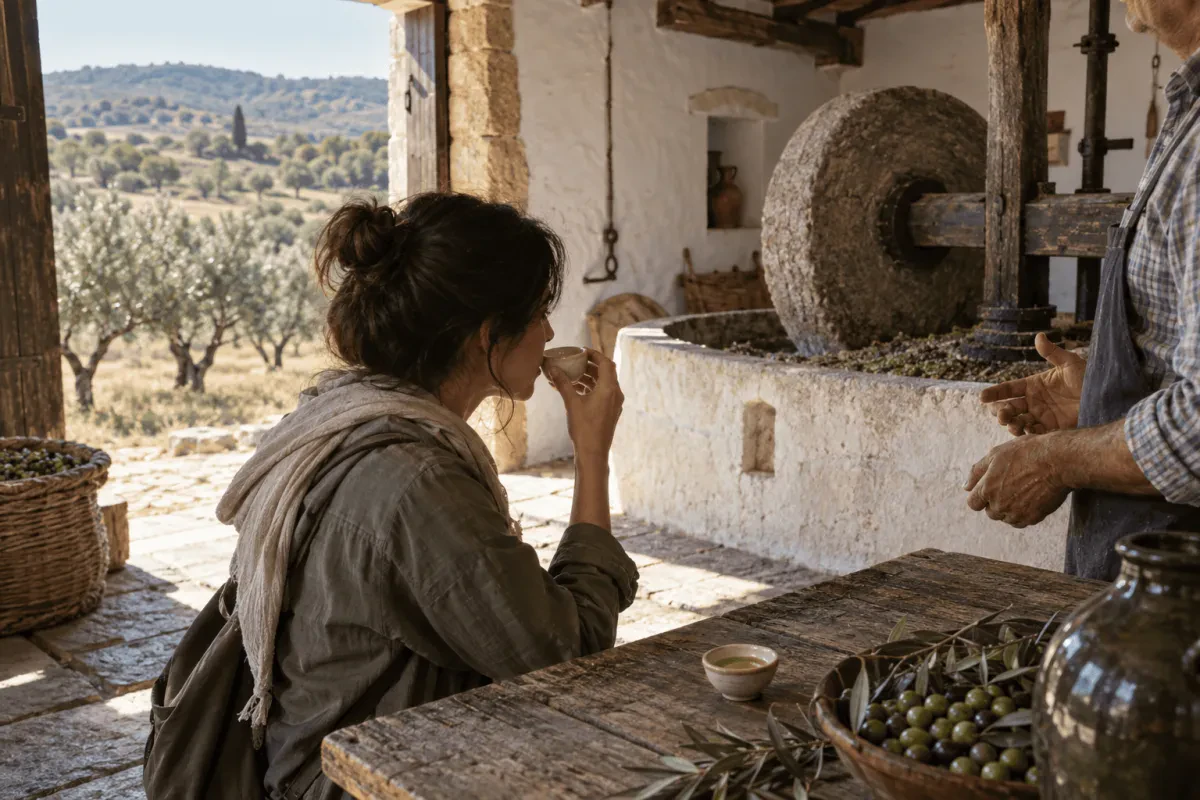
New-season olive oil calls for a degree of scepticism. In everyday use, the expression refers to the oil from the harvest campaign that has just begun, but it is not a legal category and does not, in itself, guarantee quality. On the label, designations such as “extra virgin olive oil” and “virgin olive oil” still matter. The harvest campaign may only be indicated when the entire contents of the packaging come from that campaign.
In the Alentejo, extraction generally takes place between October and February. The exact date varies with the ripeness of the olives and each producer. October may therefore be an excellent time to visit, or still too early to find the machinery running. Before leaving Évora, check directly with the producer whether the olive mill will be operating on the day booked.
What happens in a modern olive mill
The visit really begins at the olive reception area, not with the bottle. The fruit arrives at the mill, is sorted by quality and variety, cleaned, washed and weighed. Casa do Azeite gives processing within the 24 hours following harvesting as a reference for preserving quality.
Next comes milling, which turns the olives into a paste. During malaxation, the paste is mixed at a controlled temperature to help the small oil droplets come together. A continuous system then separates the pomace, vegetation water and oil by centrifugation. The product is transferred to inert-material tanks, where it remains protected until bottling.
A good visit should allow you to identify these stages, even when the line is stopped. Photographs of olive trees and a tasting at the end do not replace an explanation of fruit reception, milling, malaxation, centrifugation and storage.
“First cold pressing” and “cold extraction” are not synonyms
The term “first cold pressing” is reserved for virgin olive oils obtained below 27 ºC using a traditional hydraulic press system. In a modern olive mill using centrifugation, the appropriate expression is “cold extracted”, which is also subject to the 27 ºC limit. Asking which system is used is more informative than accepting the word “cold” as sufficient proof.
Our editorial criteria for choosing a visit
Before booking, ask five specific questions:
- Does the tour enter the olive mill, or does it only visit the winery, olive grove or shop?
- Will the line be operating on the chosen date?
- Does the tasting include different oils identified by variety, batch or profile?
- Does the guide explain how much time passes between harvesting and milling, and how the batches are separated?
- Are there access restrictions while the mill is operating, especially for children or people with reduced mobility?
As an editorial preference, we value tastings in which the olive oil is first sampled on its own and only afterwards with bread or food. Two or three contrasting oils teach more than a long succession of samples without context.
A sensory framework without theatrics
Professional assessment is carried out by trained panels, not by an individual visitor. Even so, the same language helps you taste attentively. Use a small glass, cover it with your hand and warm it slightly in your palm. Smell it before tasting. Colour should not guide the judgement, which is why professionals use dark glasses.
| Attribute | What to look for | How to record it |
|---|---|---|
| Fruity | Aromas characteristic of healthy, fresh olives, whether green or ripe. They may recall grass, leaf, apple, almond or other fruits. | Absent, slight, medium or intense; green or ripe. |
| Bitter | The characteristic taste of oils obtained from green olives or olives at the beginning of ripening. | Slight, medium or intense. |
| Pungent | A tactile sensation in the mouth and, especially, in the throat, common in oils from the beginning of the harvest campaign. | Slight, medium or intense; short or persistent. |
| Defects | Notes of rancidity, mould, damp earth, fermentation or sediment. | Record what you recognise without trying to guess the cause. |
Bitter and pungent are not defects. They are positive attributes recognised in sensory analysis. To be classified as extra virgin, an olive oil must show fruitiness, have no sensory defects and comply with the category’s physicochemical parameters, including free acidity not exceeding 0.8%. This acidity is determined by analysis and does not correspond to the acidic taste felt in the mouth.
In the Alentejo, the variety and timing of the harvest clearly alter the profile. Galega harvested green may show green apple, slight bitterness and slight pungency; when riper, it tends towards almond and nuts. Cobrançosa may be more bitter and pungent, while Cordovil de Serpa usually presents leafy green notes with pronounced bitterness and pungency. These descriptions are reference points, not answers visitors are expected to repeat.
What the PDO says, and what it does not say
A Protected Designation of Origin links the product to a defined area, a specification and certified control. It does not mean that the oil is new-season, nor does it determine on its own whether you will enjoy its profile.
In the surroundings of Évora, the PDO Azeites do Norte Alentejano is particularly relevant. The recognised area covers rural parishes in the municipality of Évora and municipalities such as Redondo, Reguengos de Monsaraz, Borba and Estremoz. Its specification allows a minimum of 65% Galega. If origin matters to you, look for the full PDO name and the European symbol on the label, not just words or images associated with the Alentejo.
Two verified options from Évora
| Location | What is confirmed | Before booking |
|---|---|---|
| Herdade do Esporão, Reguengos de Monsaraz | The official material presents a guided visit to the olive mill throughout the year, ending with three extra virgin olive oils. During the harvest campaign, the tour may follow the arrival and sorting of the olives. | Confirm whether the mill will be operating and which olive oil programme will be available on the desired date. |
| Enoturismo Cartuxa, Quinta de Valbom, Évora | Guided winery visits end with a tasting of wines and olive oils. The official page does not announce entry to the Cartuxa Olive Mill as part of the regular tour. | It is a practical option for tasting olive oil near the centre, but it should not be booked as a visit to the mill machinery without express confirmation. |
The directory is deliberately short. A general reference to “olive oil experiences” is not enough to claim that a mill accepts visitors or will be in production. Always consult the service’s official page and request confirmation for the specific day.
How to fit the visit into your itinerary
If you choose Esporão, it makes sense to continue to Monsaraz de Pedra, on a walking route inside the walls, instead of returning immediately to the city. For an experience close to Évora, combine the Cartuxa tasting with a walk through Évora’s historic centre. Those who want to keep a central base might consider M'AR De AR Aqueduto.
At the shop, ask to see the legal category, origin, harvest campaign when indicated and batch. Then return to the tasting. An olive oil is worth more for its clean fruitiness, absence of defects and balance at the table than for its green colour, isolated acidity or the word “new” written in large letters.