Porto Covo on Foot: The White Streets Between Cliff and Cove
Porto Covo fits entirely into one day of walking: from Largo Marquês de Pombal to Praia Grande, from the fishing harbor to the start of the Fisherman's Trail overlooking Ilha do Pessegueiro. An unhurried, car-free, GPS-free route.
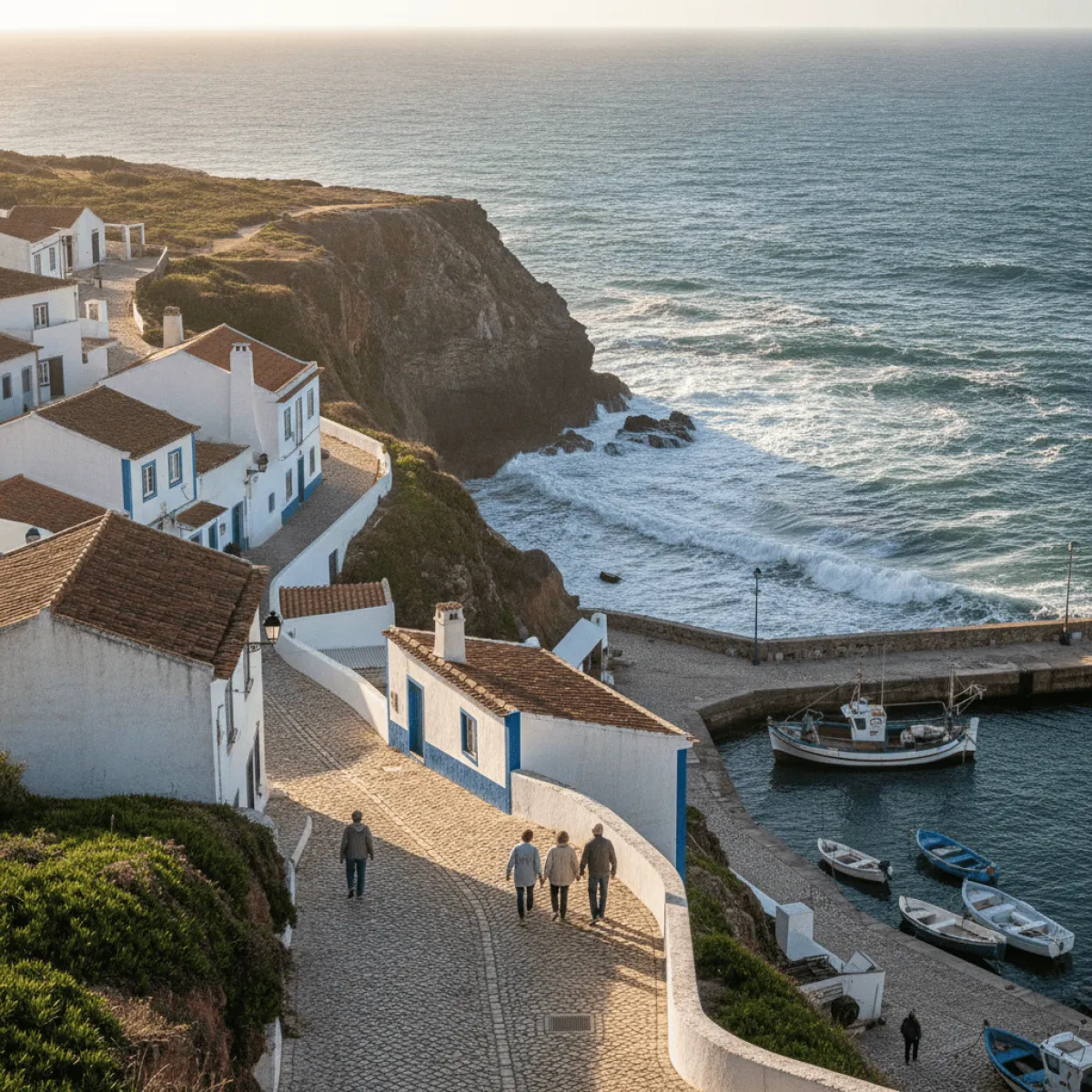
Porto Covo has no traffic lights. It barely has, to be precise, any street where a car feels welcome after 9am in August. This is a small village built in a tight grid on a low cliff, and the best way to understand it is to leave the car parked and walk. Twenty minutes on foot covers the essentials. Two hours, with stops, covers the whole village twice over.
The center: Largo Marquês de Pombal and the white grid
Everything starts at Largo Marquês de Pombal, the administrative and social heart of the village, ringed by whitewashed houses with blue trim, a color scheme repeated across Porto Covo with almost stubborn discipline. This isn't decoration for postcards: it's the same logic as the Alentejo villages further inland, adapted here to an Atlantic wind that hits straight off the sea with nothing to slow it down. Sometimes, in January, that wind is the only sound in the square at seven in the morning, before the bakery opens.
Of the streets branching off the square, Rua do Alentejo and Rua de Lisboa are the most interesting to wander without a plan: small shops, holiday homes with painted doors, and here and there a tasca that only opens for lunch. There isn't much grand architecture to photograph, and that's exactly why the village works: it's built to be lived in, not admired from outside.
Where to sleep, inside the grid or outside it
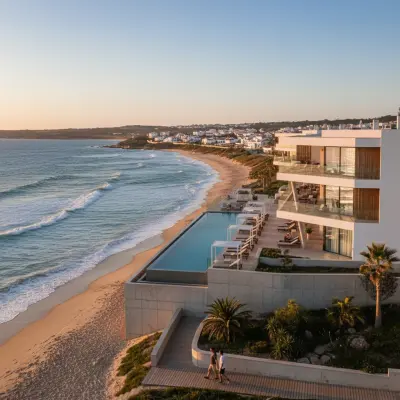
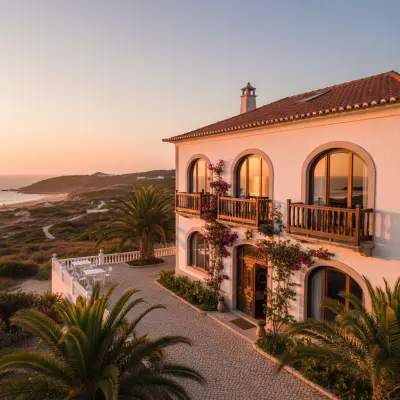
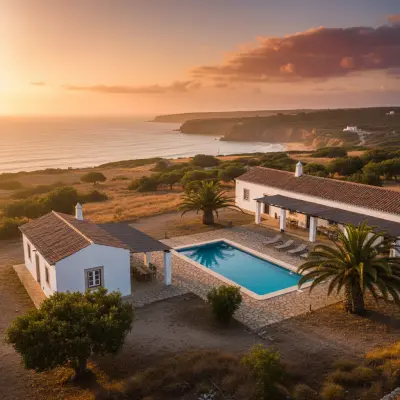
Where you sleep in Porto Covo changes the whole walking experience. Staying at the Hotel Apartamento Porto Covo, right inside the village, means waking up five minutes from everything: bakery, beach, harbor. It's the logical choice for anyone planning to leave the car parked for three or four days straight. The Porto Covo Praia Hotel & SPA offers the same proximity plus a spa and pool, which pays off on the windy afternoons when walking stops being comfortable, something that happens more often than the brochures admit. For anyone who prefers rural accommodation outside the urban core, with more quiet and less foot traffic past the front door, Monte da Bemposta is a short drive away, which requires a small mental shift: there, the walking happens in the surrounding countryside, not in the village itself.
Toward the sea: from the center to Praia Grande
The most obvious walk, and the most rewarding, links the center to Praia Grande de Porto Covo. Ten minutes on foot from the square, on a gentle downhill, and you reach a bay protected by dark rocks that break the swell, making this beach safer for swimming than most of the Vicentine coast, which is treacherous in exposed spots. In August it fills up, but never to the extent of Vila Nova de Milfontes on peak days. If dodging the crowds that month is the real goal, it's worth reading what's been written about Vila Nova de Milfontes in August, because the escape logic is similar: early morning, or late afternoon, always.
From Praia Grande, the natural walk continues north along the low cliff to the small fishing harbor. This is where you realize Porto Covo is still, before being a tourist destination, a fishing village. The colorful moored boats, the nets drying in the sun, the older men sitting on stone benches watching the sea with absolutely no rush to be anywhere else: none of this is staged for visitors.
The Fisherman's Trail and the view toward Ilha do Pessegueiro
Anyone wanting to stretch the walk beyond the village center will find, right at Porto Covo's doorstep, the start of one of the most beautiful stretches of the Rota Vicentina. The path known as the Fisherman's Trail hugs the cliff edge, with no shade and no barriers, so it demands water, a hat, and respect for the wind, which can be brutal here even on sunny days. The payoff is a continuous view over Ilha do Pessegueiro, with its ruined fort, and over a coastline that alternates between sandy coves and dark rock tongues chewed by the Atlantic.
For those who want to go further than their legs allow, there's a sea option: a small boat that crosses to Ilha do Pessegueiro itself, with all the logistics and schedules laid out in this guide to the boat to Ilha do Pessegueiro. It's worth combining both in a single day: walk the cliff trail in the morning, cross by boat in the afternoon when tide and wind usually settle down.
What to bring and when to go
- Plenty of water, even for short walks: there are no fountains or shade on the cliff path.
- A windbreaker, even in high summer. The north wind doesn't warn you.
- Closed shoes for the Fisherman's Trail, the surface is uneven in several stretches.
- Early morning or late afternoon for walking in July and August, when midday sun on the cliff is unforgiving.
Eating after walking
After a morning on foot, Porto Covo isn't the place for grand culinary ambitions, and that's fine. The tascas near the square serve simple, well-made grilled fish, and it's always worth asking what came in that day rather than picking blind from the menu. For anyone who wants to actually understand the seafood culture of this stretch of coast, from percebes to the oysters now farmed in the Mira estuary, the picture is well laid out in this guide to Odemira's seafood summer, the municipality Porto Covo belongs to. You don't need to leave the village to eat well, but understanding the context helps you order better.
Off season: a different village
Anyone who visits Porto Covo only in August sees a village that's full, lively, a little too touristy during beach hours. Anyone who visits in May, or October, finds something else: streets empty at ten in the morning, the harbor with only fishermen, wind whistling between whitewashed houses with no one taking photos. It's in that low season that walking Porto Covo becomes most rewarding, because the village stops competing for attention and simply exists. The same logic applies a little further south, around Zambujeira do Mar, where the off season completely transforms the experience for anyone chasing cliffs without crowds, as explained in this piece on Zambujeira do Mar in the slow season.
A half-day walking route
For anyone with just one morning, this route works: start at Largo Marquês de Pombal with a coffee, walk down to Praia Grande, follow the cliff to the start of the Fisherman's Trail, walk as far as the legs allow toward Ilha do Pessegueiro, and return the same way, or via the fishing harbor, which offers a different perspective of the village on the way back. That's between five and eight kilometers total, depending on how far you go on the trail, all car-free, all on terrain anyone in decent shoes can manage.
Porto Covo doesn't impress through grandeur. It impresses by being exactly the right size to walk entirely on foot in a single day, without rushing and without GPS, and by still feeling, despite everything, like a fishing village that happens to receive visitors, rather than the other way around.