Belmonte by Train: 48 Hours Without a Car
The station is called Belmonte-Manteigas, but Manteigas is thirty kilometres away on the far side of the mountain. Once you get past that, this is the easiest of Portugal's Historic Villages to do carless: castle, Jewish museum and a Roman tower nobody can explain, all in 48 hours.
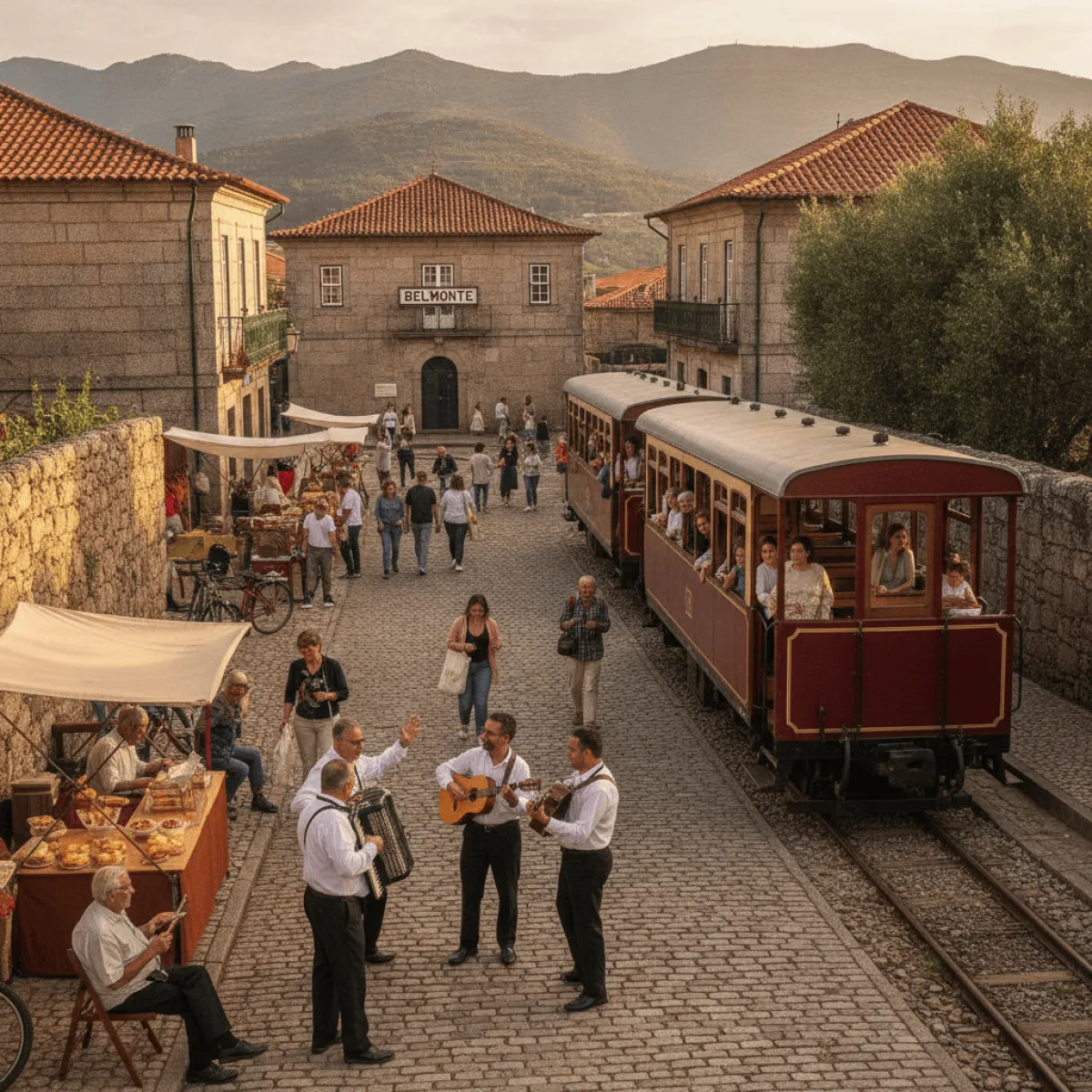
The station is called Belmonte-Manteigas, which is the first friendly lie of the trip. Manteigas sits on the far side of the Serra da Estrela, a good thirty kilometres of switchback road away, and there is no version of reality in which you walk there from the platform. The name is a leftover from an age when the railway served half a district and place names were handed out generously. Take it in good humour. It is exactly the sort of detail that defines the Beira Interior, a region that promises one thing and delivers another, usually better.
The second misunderstanding is assuming the station is in Belmonte. It is not. The village sits roughly three kilometres to the northwest and uphill, castle keeping watch over the valley. If you step off the train with a wheeled suitcase and a romantic plan to walk it, know that the final stretch climbs and there is no continuous pavement. With a backpack and decent legs it is a fine arrival. Otherwise, arrange a pickup with your accommodation before you travel, or book a taxi in advance. In villages this size taxis exist, but they are not idling in the square waiting for you at nine at night.
Getting there, and why the train actually makes sense
Belmonte sits on the Linha da Beira Baixa, the line that climbs from Lisbon through Entroncamento, Castelo Branco, Fundão and Covilhã. The Covilhã to Guarda section was shut for twelve years and reopened in May 2021, which put Belmonte back on the rail map after a decade in the dark. Both Intercidades and Regional services call here. I am not going to invent timetables: check cp.pt before you commit, because frequency is modest and a missed connection in Belmonte costs you a large chunk of your day.
The reason to arrive by train is not virtue, it is convenience. Everything that matters in Belmonte sits inside a ten minute walk: castle, museums, synagogue, church, cafés. It is one of Portugal's twelve Historic Villages and probably the easiest of them to do carless. You only need wheels when you want to leave the perimeter, and even then there are workarounds.
Day one, afternoon: granite, a Manueline window and the man from Brazil
Drop the bag and walk up to the castle. It is small and built of honest granite, and what rescues it from being just another border fortress is the Manueline window set into the wall, a decorative oddity that has no business being there and is all the better for it. From the top you get the Zêzere valley and, on clear days, the ridge of the sierra closing the western horizon. Stand still for ten minutes. Belmonte does not reward brisk walking.
Next door is the Romanesque Igreja de Santiago, austere and cool, with the Cabral family pantheon attached. Pedro Álvares Cabral was born in this village, a fact Belmonte deploys with surprising restraint by Portuguese standards. There is a statue, there is a Discoveries museum, and then there is the other history, which is the genuinely extraordinary one and has nothing to do with Brazil.
Buy the combined ticket. At the time of writing it hovered around 10 euros per adult and covered half a dozen of the village museums and monuments, which makes the maths ridiculous in your favour over two nights. Confirm the price and inclusions locally, because these things change without notice.
For dinner, a note of honesty: I will not recommend restaurants I cannot vouch for, and in small villages kitchens change hands. What I can tell you is what to look for on the menu. Roast kid, cabrito assado, cooked properly here rather than as a nod to tourists. Serra da Estrela DOP cheese, ideally between November and April when it is at its buttery best rather than the anaemic paste you get in August. Regional cured sausage. And a Beira Interior red, an underrated denomination producing altitude wines with real acidity. Book a table, especially on Sunday nights, when half the region's restaurants collectively decide to rest.
Day two, morning: the secret Belmonte kept for four centuries
This is why you come, even if you did not know it before arriving. After the forced conversion and expulsion of Portugal's Jews at the end of the fifteenth century, a community in Belmonte went on practising Judaism in secret. Not for a generation. For roughly four hundred years, passing prayers down by memory, lighting candles inside cupboards, marrying within the group, keeping Passover on a calendar of their own devising. In 1917 a Polish mining engineer named Samuel Schwarz worked out what was happening and wrote about it. The outside world discovered that crypto-Jews were alive and functioning in twentieth century rural Portugal.
The Bet Eliahu synagogue opened in 1996. The Jewish Museum of Belmonte opened in 2005 and was the first museum in the country devoted entirely to the history of Portuguese Judaism. The objects run from the Middle Ages to the twentieth century, and many of them were genuinely used, at home, out of sight. Go early, when it is empty, and read every panel. It closes on Mondays and runs different summer and winter hours, so check before you plan your morning around it.
If you want to get past the display cases, it is worth booking a private tour of Belmonte's Sephardic history. The gap between reading a wall text and hearing someone explain why certain families still will not discuss this with strangers is the gap between visiting and understanding. It is also the only way to leave without the nagging sense that you toured a handsome museum and touched nothing.
Day two, afternoon: the Roman tower nobody can explain
About five kilometres from the village, at Colmeal da Torre, stands the Torre de Centum Cellas. It is a block of Roman granite from the first century, three storeys high, with windows in improbable places and no agreed explanation. A villa? A praetorium? A roadside station? A temple? Archaeologists have been arguing for decades. What nobody argues about is the effect of seeing it in late afternoon light, alone in open farmland, swifts flicking in and out of the empty openings.
Without a car you have two options. Walk it, roughly an hour on a secondary road with light traffic but no reliable verge in places, so wear something visible if you go late and skip it entirely with small children. Or take a taxi, agreeing the return time before you get out, because there is nothing there but the tower and the fields. My advice: walk out early while it is cool, taxi back if your legs file a complaint.
The seated alternative for the afternoon is a tasting at Quinta dos Termos, right here in the municipality. This is one of the estates that built the reputation of Beira Interior back when almost nobody was paying attention to the region, and tasting the wines with the vines in view genuinely changes how the glass reads. Book ahead and sort transport in the same phone call, because you cannot walk there and because, let us be practical, tastings and driving do not mix.
Where to sleep: three houses, three characters
Belmonte has no chain hotels, which is a mercy. What it has are places with owners, meaning the quality of your stay depends heavily on who you land with.
- TheVagar Countryhouse: the pick for contemporary comfort if you do not mind being slightly outside the centre. Good for couples and for anyone who rates a breakfast worth getting up for.
- Kazas do Serado: classic rural tourism, stone and timber, the kind of place where lighting a fire is not an affectation. Best in November, when the Beira turns damp and grey and that is precisely the point.
- Quinta do Rio: for groups and families who want space, a kitchen and the option of cooking in. Useful when restaurants close earlier than you expected.
Whichever you choose, ask at the point of booking whether they collect from the station. Many will, or will point you at the right taxi driver, and that single question solves the only real logistical problem Belmonte presents.
If you have spare time: the line keeps going
The advantage of doing the Beira Baixa without a car is that the railway acts as your spine. Covilhã is a short hop south and is the natural base for a one day run out to the schist villages, though for that leg you will need a rental or an organised tour. Fundão is on the same line and, in March or early April, transforms completely: this is the window for the cherry blossom on the Serra da Gardunha, a two week spectacle that almost no foreign visitor has heard of.
As for Manteigas, station name notwithstanding, forget the train. You get there by road, up the Zêzere glacial valley, and it is one of the best mountain drives in the country. If you can borrow wheels, the snow wells trail above Manteigas is the Serra da Estrela without cable cars or crowds. Save it and come back with a car.
When to go and what to pack
May, June and September are the sweet spot: long days, tolerable heat, empty museums. July and August bring returning emigrants, village festivals and valley temperatures well past 35 degrees. Winter is properly cold, with fog and the chance of snow on the ridge behind, and it has its own appeal if you like wet granite villages and cheese at its peak. Bring shoes that cope with uneven cobbles, a windproof layer even in June, and some cash for the days when the village ATM decides to have opinions.
Belmonte cannot be done in two hours, and two days will not exhaust it, but forty eight hours is enough to grasp something rare: this is a village that kept a secret for four centuries and now tells it with disarming matter of factness. You arrive for the castle and for Cabral. You stay for the other story.