Miradouro da Parada do Castelo
Right against the castle walls in Bairro Rui de Mello, this viewpoint has no ticket booth and no schedule, just the Alentejo plain stretching to the Spanish border. Go late afternoon, when the walls turn warm in the low light.
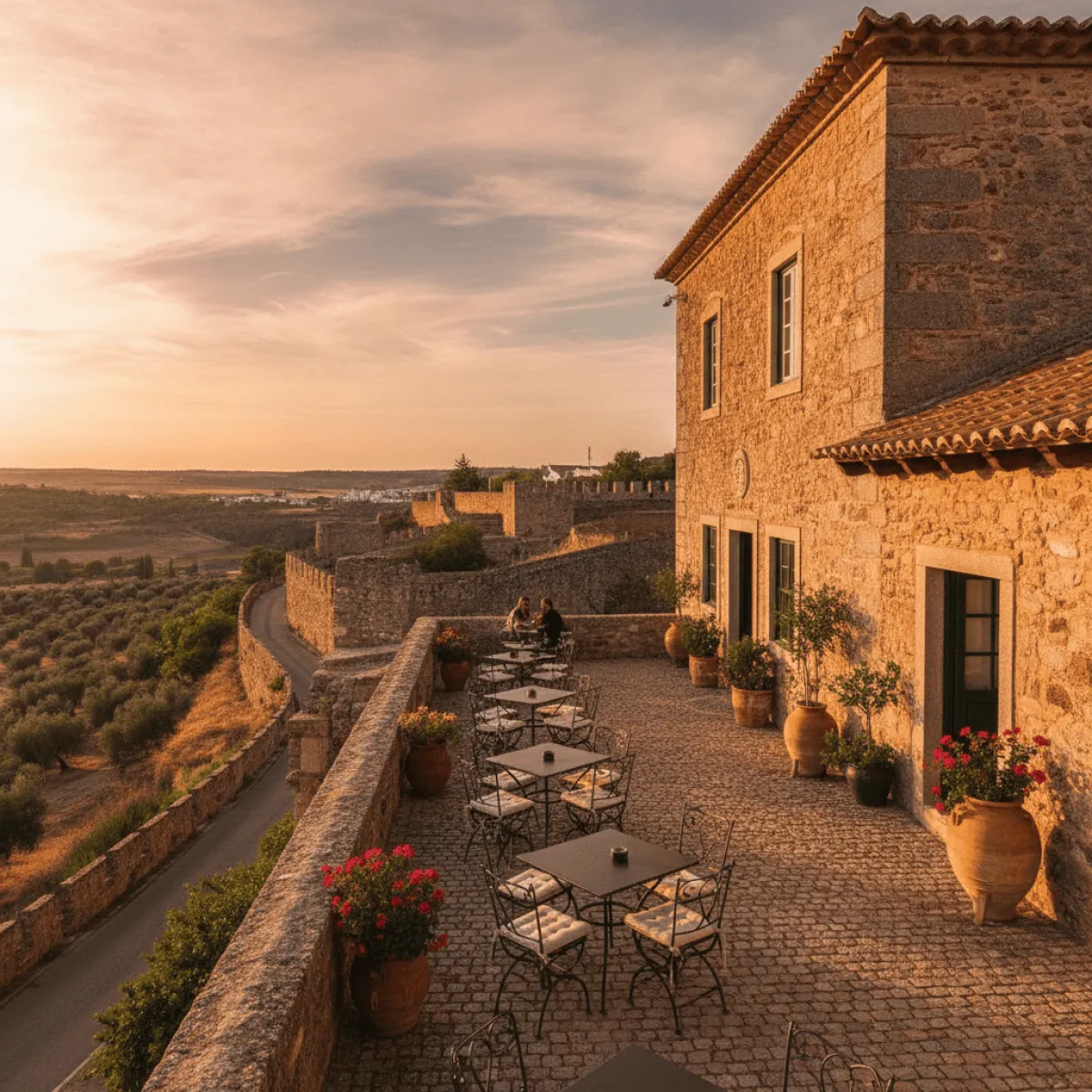
Miradouro da Parada do Castelo: Elvas seen from its highest point
The Parada do Castelo viewpoint sits exactly where its name suggests: right against the castle walls, in the Bairro Rui de Mello, at the highest point in Elvas. There's no ticket booth, no gates that close at dusk, not even a posted schedule. It's an open spot, and that lack of infrastructure is what sets it apart from more polished, tour-bus viewpoints elsewhere: you walk up, you look, you stay as long as you want, and you leave without having paid a cent.
What you actually see from up there
Elvas was built to be seen from a distance and to see anyone approaching from one, and that logic is obvious from this viewpoint. The city is a star-shaped bulwarked fortress, a UNESCO World Heritage site, with the castle, medieval in origin and reinforced over the following centuries, sitting at the highest point of the old town. From the Parada, the view first drops over the rooftops of the old city and the geometric lines of the bastions that define the fortification, then opens onto the Alentejo plain: flat farmland, open horizon as far as you can see, with the Spanish border just a few kilometers away. Unlike an urban viewpoint built around one pretty facade to photograph, this one is about scale. You come here to understand the military logic of the city, not to hunt for a decorative detail.
Getting there
Access is on foot, walking up from the historic center to the Bairro Rui de Mello, right by the castle walls. Parts of the climb are on traditional Portuguese cobblestone, so wear comfortable shoes, especially after rain, when the stone gets slick. There's no dedicated parking right by the viewpoint; if you're driving, leave the car lower down near the center and walk up, which is also the better way to actually notice the city instead of driving through it.
When to go
Since there's no fixed schedule, the practical answer is: whenever the light is good. Late afternoon, with the sun low over the plain, turns the stone of the walls a warm color you don't get at midday. Early morning, before the heat sets in (and in the Alentejo, between June and September, it sets in hard), the viewpoint is usually empty, which is unusual for a spot with this kind of view. Avoid going alone after sunset: the area around the walls doesn't have strong public lighting.
Practical tips
- Free entry, no ticket, no reservation needed.
- No restrooms or services on site; use the ones in the center before you climb.
- Bring water, especially in summer: there's no shade and no kiosk at the viewpoint.
- There's no café at Parada do Castelo itself. For coffee before or after the climb, both Troya Coffee and Coffee Time Aqueduto are in the center, a few minutes' walk away.
- Closed, comfortable shoes: the cobblestone is uneven in several stretches of the climb.
Where to stay and what to do next
If you're planning a stay in Elvas, it's worth sleeping inside or near the walls so you can come back to the viewpoint more than once: morning and late afternoon light are completely different up there. Vila Galé Collection Elvas is the most central option if you want a hotel, while Alojamento Escola do Fado suits travelers who prefer something smaller and steeped in more history. In the evening, it's worth seeking out a fado session in the city: Arkus - Associação Juvenil hosts evenings that are worth the detour.
If you're traveling with kids, the viewpoint itself is safe, the walls have a protective parapet, but the climb can be long for short legs. The honest family guide to Elvas has suggestions on how to pace the day without wearing everyone out. If your trip falls in summer, it's worth checking the dates for the São Vicente e Ventosa Summer Festival or browsing the local festival calendar for Elvas: the city organizes much of its life around these dates, and the viewpoint tends to get busier on festival nights, with locals climbing up to watch the fireworks from above the walls.
After the climb, if there's still time and heat left to burn off, the Caia reservoir is about a 15-minute drive away and is the most efficient way to cool down without leaving the municipality.
Is it worth it?
Yes, without hesitation, and it costs nothing. The Parada do Castelo viewpoint has no infrastructure, no explanatory signs every few meters, no café charging for the view. It has walls, a plain that stretches out of sight, and quiet, which these days is rarer than any panorama.
