Aveiro Beyond the Canal: Tile Facades Nobody Photographs
Aveiro's old railway station is covered in tile panels from the Fonte Nova factory, and almost everyone walks straight past them. From the fully tiled Misericórdia church to the patterned backstreets of Beira Mar, the city's best sight isn't on the canal: it's bolted to the walls.
Every hour, trains from Porto empty onto the platform at Aveiro and a small crowd walks straight past the best free sight in town. The old station building, preserved next to the modern one, is covered in early twentieth century tile panels from the Fonte Nova factory, the local ceramics works that shaped the city's identity. The panels show Aveiro as it saw itself a century ago: moliceiro boats on the lagoon, salt workers in the pans, regional dress. No ticket, no queue, no gift shop. Ten minutes here, ideally in morning light when the blues deepen, sets up the whole argument of this guide: Aveiro's canal and its painted boats are the postcard, but the real show is bolted to the walls, and most of it faces away from the water.
Why the tiles are everywhere
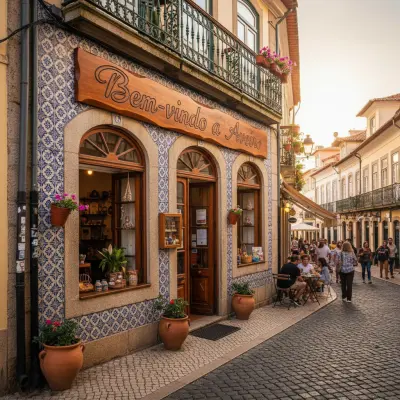
Aveiro was a ceramics town. Through the nineteenth and early twentieth centuries its factories turned out tiles by the thousand, and the city clad itself in its own product. This was not decoration for tourists. Azulejo was practical armour: it kept the lagoon damp and salt air out of the walls and was cheaper to maintain than painted render. The result, a hundred years on, is a city where entire streets function as an open air catalogue of Portuguese tile, with no explanatory plaques and, outside two or three spots, no crowds. All you need is a flat pair of shoes and the discipline to keep looking up. Aveiro helps: the town is almost entirely flat and compact, one of the easiest walking cities in Portugal.
Praça da República: a church wearing its tiles on the outside
Fifteen minutes on foot from the station brings you to Praça da República, where the Misericórdia church stands beside the town hall. This is where you learn the local rule: in Aveiro, azulejo is not an interior finish, it is the skin of the building. The facade is tiled from pavement to roofline, framing the stone portal. Most visitors take one photo of the square and move on. Do the exercise you will repeat all day instead: cross to the far side of the square to see the facade as a single surface, then walk up close and read the pattern tile by tile. Distance gives you the effect, proximity gives you the drawing.
Beira Mar: the neighbourhood that is an accidental showroom
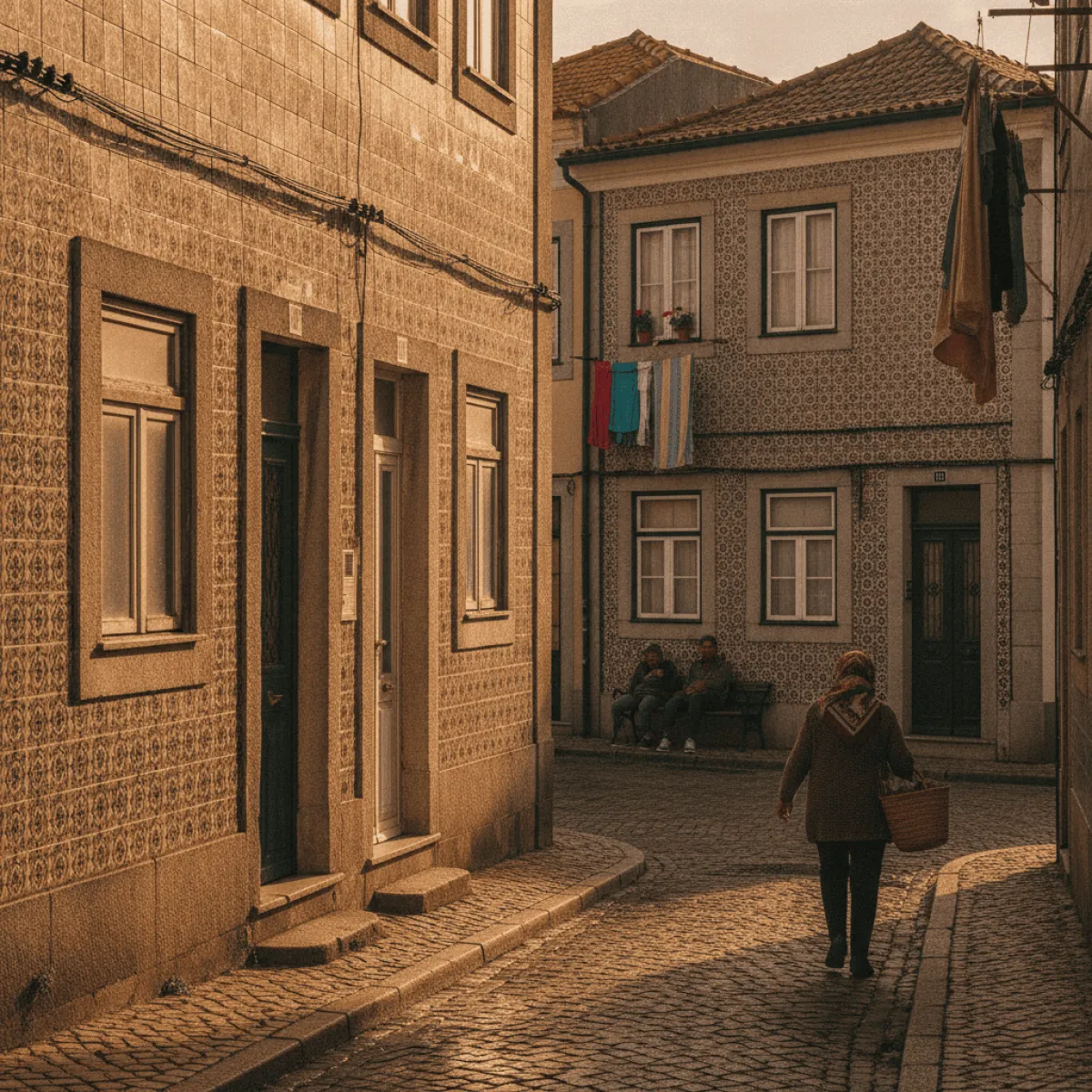
The main event is across the central canal in Beira Mar, the old quarter of fishermen and salt workers. In the narrow streets between the Praça do Peixe fish market square and the São Roque canal, low houses stand shoulder to shoulder in patterned tile: greens, blues, yellows, geometries that repeat from door to door but never quite the same way twice. Walk without a map and without a schedule. You will eventually arrive at the chapel of São Gonçalinho, the small heart of the district. If you are in Aveiro in early January, you can catch the saint's festival, when cavacas, hard sugar coated cakes, are thrown from the chapel roof to a crowd below trying to catch them with nets, upturned umbrellas and whatever else comes to hand. It is one of the strangest and most likeable festivals in the country. The rest of the year, the chapel and its square are worth the detour for their scale alone: everything small, everything built to the measure of the people who lived here.
If you want context rather than wandering, the Aveiro walking tour through the Art Nouveau buildings and the Beira Mar district covers exactly this ground with someone who can tell a locally made tile from a modern reproduction, which permanently changes how you look at the rest of the city.
Art Nouveau: when tile went modern
Aveiro has a second ceramic tradition, this one with museum pedigree. In the early 1900s the town's newly wealthy commissioned houses with curving facades, wrought iron and purpose designed tiles, floral and animal motifs instead of the repeating patterns on the fishermen's houses. The star is Casa Major Pessoa on Rua Dr. Barbosa de Magalhães, now the Art Nouveau Museum, with a tea house on the ground floor. But the interesting thing about Aveiro's Art Nouveau is that it never got locked away: it is scattered across facades around the Rossio garden and the canal, many still ordinary homes and shops. The practical rule: wherever you see wrought iron making curves, look up. The special tilework is usually in the upper frieze, exactly where nobody looks.
Where to stay to do it all on foot
Choosing a bed in Aveiro is mostly a question of geography, and distances are mercifully short. Welcome In Aveiro is the solid central base with no complications. If you would rather wake up beside the canal and the Rossio garden with Art Nouveau facades on your doorstep, Aveiro Rossio Bed & Breakfast puts the most photogenic buildings in town two minutes away. And if you have read the section above and concluded, correctly, that Beira Mar is the main course, Cais do Pescador puts you inside the quarter itself, which means having the tiled streets to yourself at eight in the morning before the groups arrive. That is precisely when they should be seen.
Eating between facades
You do not leave Aveiro without ovos moles, and there is no point pretending otherwise. They were the first Portuguese sweet to earn Protected Geographical Indication status: egg yolk and sugar sealed inside thin wafer shaped as shells, whelks and fish, a direct nod to the lagoon. Confeitaria Peixinho, founded in 1856 on Rua de Coimbra, is the historic house and remains the correct answer. Buy a few and eat them the same day; fresh, they are a different product. The street food alternative is the tripa, a thick folded crepe filled to order and eaten hot while walking; the ovos moles filling is the one that makes sense here. At night, the area around Praça do Peixe becomes the social centre of the quarter, with terraces and bars set into the tiled buildings. Go at least once, if only to see the facades lit up.
When you run out of tiles: salt, a lighthouse and waves
On the way out towards the lagoon mouth, along the Canal das Pirâmides, you pass the salt pans, including Marinha da Troncalhada, a traditional working salina turned ecomuseum that you can see well from the walkway; for guided visits, check locally. Then take the bus to Barra, home to the tallest lighthouse in Portugal, where the open Atlantic makes you forget the lagoon's calm in about thirty seconds. If your trip has a spare day, surf lessons at Praia da Barra are the most honest way to meet this coastline, with beginner friendly waves and a wide beach. Just beyond sits Costa Nova, whose famous striped wooden houses are, at heart, the timber version of the same logic as the azulejo: paint the house to protect it from the sea, and while you are at it, to tell it apart from the neighbour's.
Practical notes so the day works
- Arrive by train and see the old station panels before you even drop your bags. From Porto the urban train takes about an hour and costs a few euros; from Lisbon the Intercidades takes a little over two hours. Check CP timetables.
- Early morning is Beira Mar's best hour: good light, empty streets, tiles with nobody standing in front of them.
- The city is flat and small. Everything in this guide is walkable except Barra and Costa Nova, both served by bus.
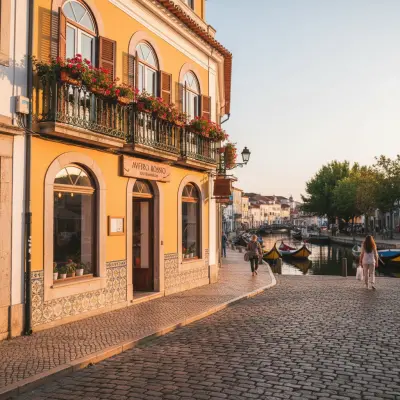
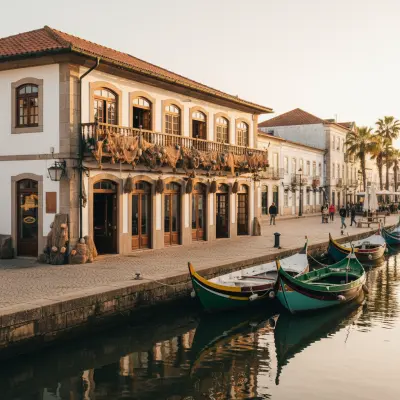
- The moliceiro canal ride is worth doing once, roughly 10 to 15 euros depending on season, confirm at the quay. Do it after seeing the facades: you will understand the references painted on the boats.
- Early January brings the São Gonçalinho festival; summer brings crowds to the canal, but Beira Mar stays quiet in the morning.
Aveiro gets sold as the Portuguese Venice, a lazy label that reduces the town to three canals and a queue for a boat. The better description is this: a city that worked ceramics until they covered its walls, then left the whole inheritance out in the open for anyone willing to lift their head. The canal is the postcard. The facades are the city.