The Alentejo the Romans picked first
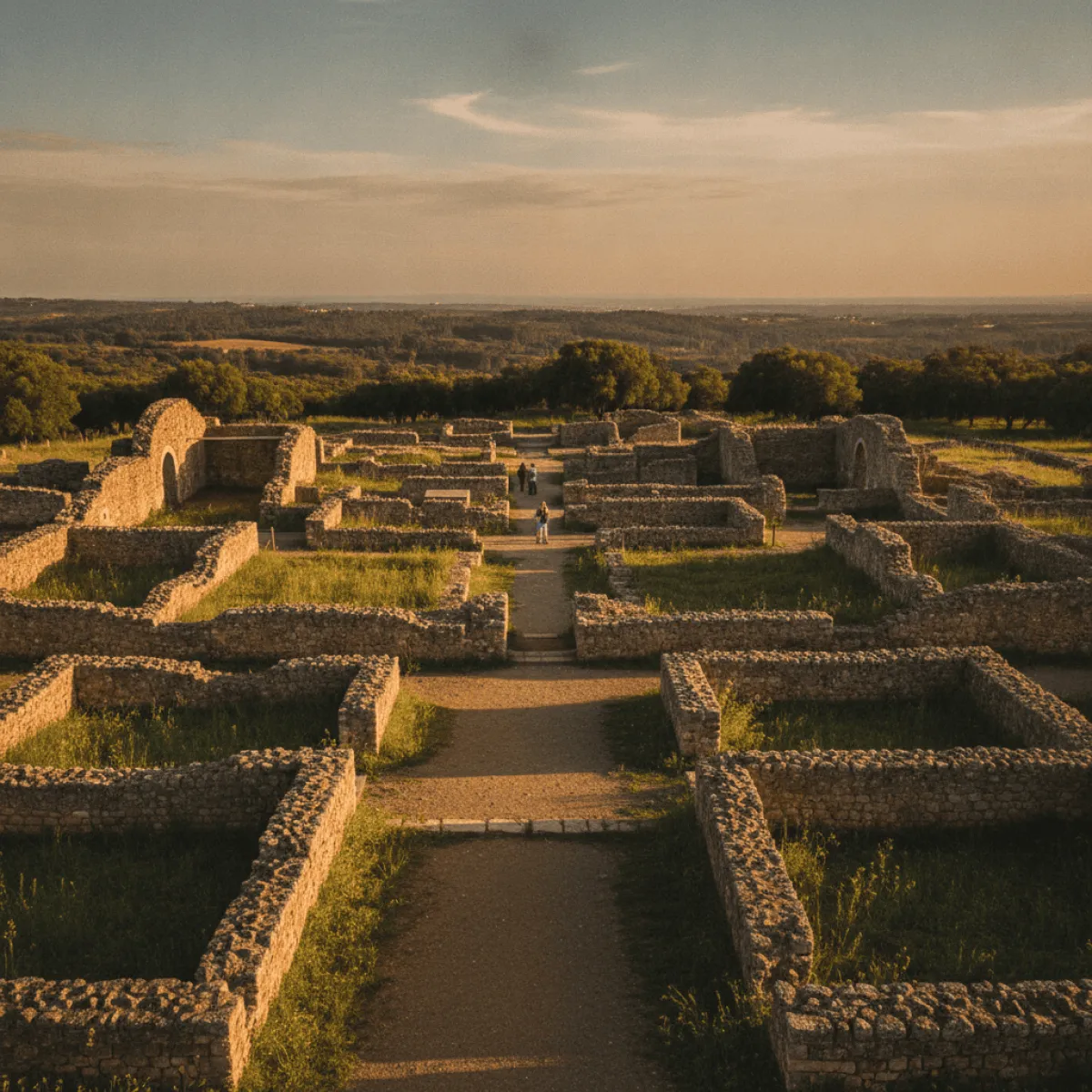
Long before Santiago do Cacém existed as a town, people were already here taking hot baths, praying to Neptune and Aesculapius, and betting on horse races. The Roman Ruins of Miróbriga sit just outside the current town center, on Estrada Nacional 261 in Herdade dos Chãos Salgados, and they are what remains of a Roman city built on top of an earlier Iron Age settlement. This is not a reconstruction and not a stage set: it is original ground, stone on stone, out in the open, with the Alentejo hills as backdrop.
What actually deserves your time
The site splits into two main areas, and it is worth walking between them slowly. First, the forum and temple area, on the highest point: the Roman temple, with its staircase and partially rebuilt columns, is the image most people associate with Miróbriga and the one you will see photographed most. Then, downhill, the thermal baths: a bathing complex where the layout of cold and hot rooms is still perfectly readable in the standing walls, proof that Romans took the concept of a spa seriously long before it became a hotel marketing term.
And then there is the hippodrome, which tends to surprise people who did not know it existed: it is one of the few identified Roman hippodromes on the Iberian Peninsula, with excavated seating and the track layout still visible on the ground. Nothing dramatic is happening there now, and that is exactly the point: you can picture the noise of wheels and wagers without anyone trying to sell you an immersive-experience ticket for it.
Getting there and when to go
Driving is the practical option: the site is roughly 2 km from the center of Santiago do Cacém, with parking right by the entrance. There is no direct public transport to the ruins, so if you are staying without a car, plan on a taxi or arranging a ride. If you are sorting out where to sleep in the area, it is worth looking at Casas da Moagem, rural tourism, which sits reasonably close and fits well into a full day covering the archaeological site and the town.
Go in the morning, especially between May and September: there is almost no shade anywhere on site, and Alentejo at midday does not go easy on anyone. Bring a hat, water, and proper shoes, the ground is uneven, loose stone and packed earth, not a place for heels or thin sandals. There is no café or restaurant on site, so plan to head back into town for lunch afterward.
Practical details worth knowing
- Entry is priced in the low bracket (€) confirmed for this site.
- There is no publicly confirmed official schedule, so it is worth calling ahead to confirm hours, especially outside peak season.
- Direct contact for information and to confirm timing: +351 269 818 460.
- There is no active official website to check online, the phone is genuinely the more reliable route.
- No advance booking is needed for individual visits.
Who this is for
Miróbriga is not Rome or Mérida, and it does not pretend to be. It is an archaeological site on a human scale, without crowds, where you literally walk over history without a barrier every two meters. Good for people who like history without needing an audio guide to narrate every step, good for families with kids who want to run around open space, and good for anyone visiting Santiago do Cacém who wants to understand why this region has been continuously inhabited for over two thousand years.
If you are planning your days here on a tight budget, this is one of the cheapest and most rewarding stops in the area, and it fits naturally into an itinerary built around Santiago do Cacém on a budget, missing nothing. And if the day turns cloudy or wet, remember this is an uncovered outdoor site, so it is worth checking the alternatives laid out in this guide to rainy Santiago do Cacém indoor options before committing to a visit that day.
After the ruins
Pair the visit with the town of Santiago do Cacém itself, just minutes away, with its castle, main church, and a historic center you can walk in under an hour. If you are staying for the evening, nightlife in town is modest but it exists, with Discoteca Alexander's one option for those wanting to stretch the night out. And if the plan is to extend the trip to the coast, there are beaches a short drive away worth the detour, covered in detail in this guide to beaches without the crowds.
Miróbriga does not need a sales pitch. What it needs is time, the right shoes, and an early start. The history handles the rest on its own.