Historic centres with reduced mobility: plan without false promises
A city is not accessible by decree: assess the complete route, confirm gradients, surfaces, toilets and transport, and use Lisbon, Porto and Braga as planning case studies.
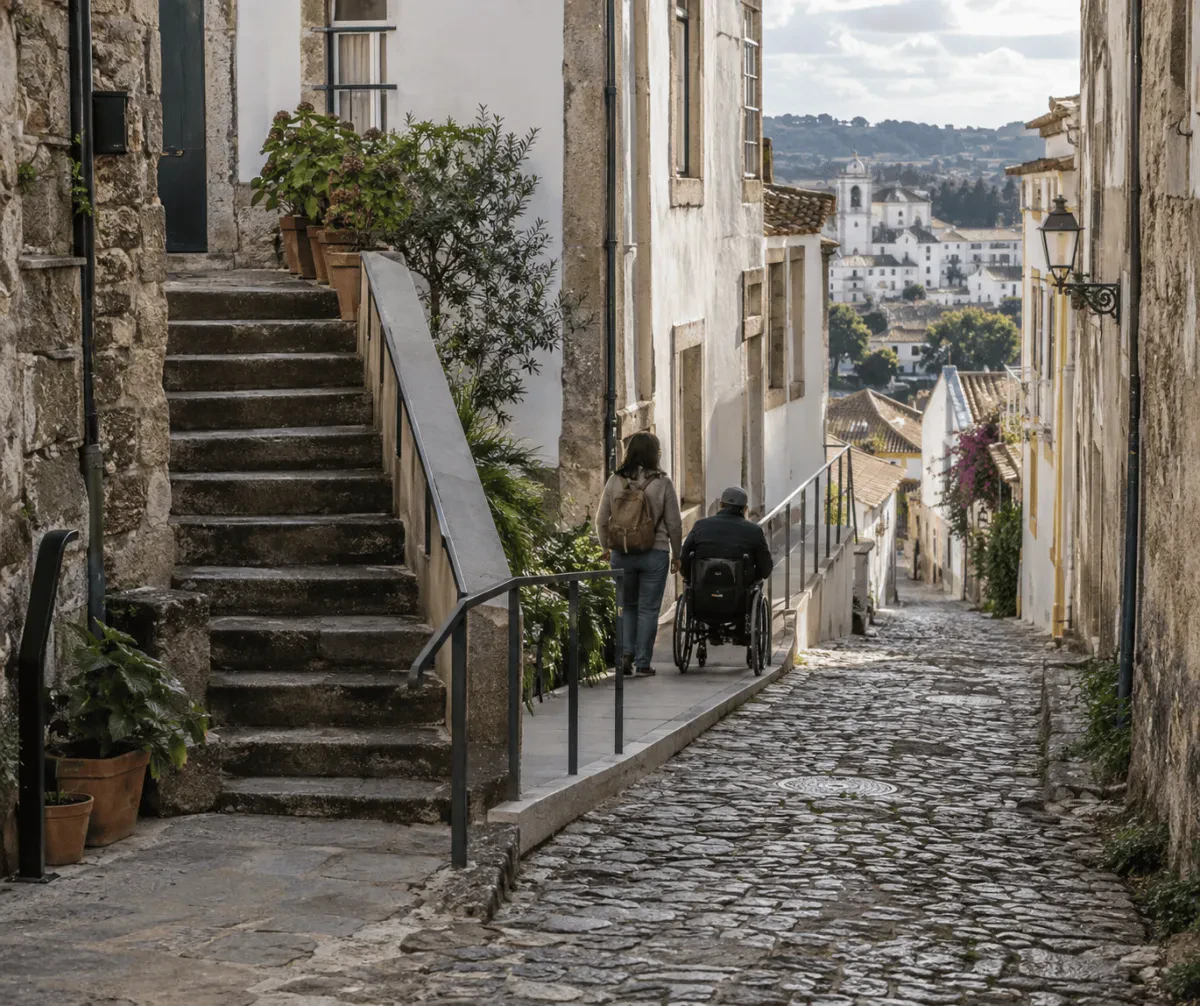
A pedestrian street is not necessarily an easy street. A museum with a ramp may be at the end of an impractical uphill stretch. A station with a lift does not solve the journey if the right exit is inaccessible. In Portugal's historic centres, the useful question is not «Is the city accessible?». It is «Does this route, with these entrances and these transport options, work for me?».
Reduced mobility does not describe a single need either. Someone who uses a manual wheelchair, someone who operates a mobility scooter, someone with crutches and someone who needs frequent breaks may encounter different obstacles on the same block. That is why the planning unit should be the complete route, from arrival to return.
The matrix that matters before booking
Turismo de Portugal recommends finding out in advance what conditions exist and identifying the destination's constraints. The TUR4all platform shows why a useful description needs details such as reserved parking, ramps, door widths, interior circulation and lifts. The word «adapted» on its own says very little.
| Barrier | What to confirm | Insufficient answer |
|---|---|---|
| Arrival | Exact drop-off point, distance to the start of the route and whether there are kerbs or stairs along the way. | «You can stop nearby.» |
| Gradient | Where the uphill section starts, how long it continues, whether there is a level area to rest and whether the return requires the same effort. | «It is just a slight incline.» |
| Surface | Type of surface, uneven areas, joints, potholes, tracks and the actual clear width between outdoor seating, poles or vehicles. | «The street has been renovated.» |
| Crossings | Lowered kerbs, central islands, audible or tactile signals and the time available to cross. | «There are pedestrian crossings.» |
| Entrance | Which door is step-free, whether it is open throughout the opening hours, who puts out the ramp and whether the wheelchair or scooter fits. | «There is side access.» |
| Interior | Steps between rooms, lift, passage widths, capacity and whether the visit can be completed without transfers. | «The building is accessible.» |
| Toilet | Location along the route, opening hours, step-free access, grab bars, transfer space and whether a key or authorisation is needed. | «There is an adapted toilet in the area.» |
| Breaks | Benches, shade, shelter and an indoor place where the route can be interrupted. | «There are cafés along the way.» |
| Return | Step-free alternative, transport availability and a plan for a lift breakdown or service change. | «It is downhill all the way back.» |
Three published routes, read with caution
The following sections are an editorial reading of itineraries published by VisitPortugal, not an on-site inspection or a guarantee for the day of travel. They are intended to show how accessibility changes from street to street and even between spaces in the same building.
Lisbon: Praça do Comércio, Rua Augusta and Rossio
The most predictable section: the published itinerary describes Rua Augusta as pedestrianised, recommending the side lanes to avoid the outdoor seating. In Rossio, it mentions flat, regular paving and lowered pedestrian crossings.
Where the promise ends: the terrace of the Arco da Rua Augusta requires a narrow staircase. Continuing through Baixa to São Jorge Castle involves very steep streets, and the itinerary itself advises anyone with mobility difficulties to use an adapted vehicle.
A sensible decision: treat Praça do Comércio, Rua Augusta and Rossio as a route of their own. Do not automatically add Alfama and the Castle to the same outing. Before setting off, confirm the accessible exit from the transport, a suitable toilet along this route and the condition of Rua Augusta's side lanes.
Porto: São Bento and the descent to Ribeira
The starting point: the published itinerary indicates a ramp at the side entrance of São Bento Station. This does not make all the routes that follow equivalent.
The choices that change the route: the climb from São Bento to the Sé is classified by the page itself as partially accessible and not independent for some people. On the descent to the river, Rua das Flores is described as having small level changes of 3 to 4 centimetres; Rua de Mouzinho da Silveira has a gentle but prolonged incline.
A sensible decision: choose between unevenness and continuous effort according to the wheelchair, available strength and support on hand. It is also necessary to plan the return before going downhill. A mechanical connection only counts as a plan when its operator confirms that it is working and that the entrance can accommodate the equipment being used.
Braga: pedestrian route from the Arco da Porta Nova
The published setting: VisitPortugal describes much of the historic centre as flat, with regular paving, many pedestrian streets and rest areas. The crossings on the itinerary are presented as mostly level or lowered.
The detail that prevents an overall classification: only some crossings have tactile, visual or audible signals. The page describes the area around the Sé and its entrance as accessible, but indicates a small staircase to the Sé Treasury. The Chapel of Nossa Senhora da Torre is marked as difficult because of the entrance staircase and interior barriers.
A sensible decision: use the pedestrian route as a base and assess each interior separately. «Getting to the Sé» and «visiting all the Sé's facilities» are two different tasks.
The questions that require a useful answer
When contacting a tourist office, monument, restaurant or operator, describe the equipment and the specific limitation. Instead of asking only whether there is accessibility, use closed questions:
- Is the step-free entrance the usual entrance or a side door?
- Is that door available throughout the visiting hours?
- Is the ramp fixed? If it is portable, who puts it in place and how do you request it?
- Is there any step between the street, ticket office, rooms and toilet?
- What is the clear width of the door and lift?
- Does the toilet allow transfer from the side I need?
- Is there an uneven section of paving or a prolonged uphill stretch between the transport and the entrance?
- Is there a safe place for drop-off and collection by an adapted vehicle?
- If the lift breaks down, is there a step-free alternative?
- Are works, events or outdoor seating currently altering the route?
Ask for photographs of the entrance and toilet when the answer remains vague. A frontal photograph of the ramp is not enough: it is also useful to see the pavement, threshold, door opening and manoeuvring area.
Transport: confirm the journey, not just the vehicle
The accessibility of a bus or train is only one part of the journey. You need to confirm the stop, platform, level difference when boarding, the chosen exit and the route to the street.
CP maintains the Integrated Mobility Service and its own list of stations offering assistance to people who use wheelchairs or scooters. Conditions and the notice required for booking may change, so they should be checked directly on the service page for the specific journey. The booking should only be considered complete once confirmation has been received.
On urban transport, confirm the direction of travel and the exact station. Two exits from the same station may lead to opposite sides of an avenue, and one may require crossing or tackling a gradient that the other avoids.
An honest plan fits on one page
- Define your personal limits: distance, tolerable incline, type of surface, need for a companion and interval between breaks.
- Map the complete chain: arrival, route, entrances, toilet, food, rest and return.
- Record every obstacle: do not hide a step or uphill section under the generic classification «partially accessible».
- Confirm with direct sources: the transport operator, municipality and venue you plan to visit. Note the date and the name of the service that replied.
- Prepare a short alternative: a flat route, an indoor space and return transport that do not all depend on the same lift.
The best itinerary is not the one that includes the most monuments. It is the one that eliminates avoidable surprises and leaves room to stop, change direction or abandon an entrance without losing the rest of the day.
